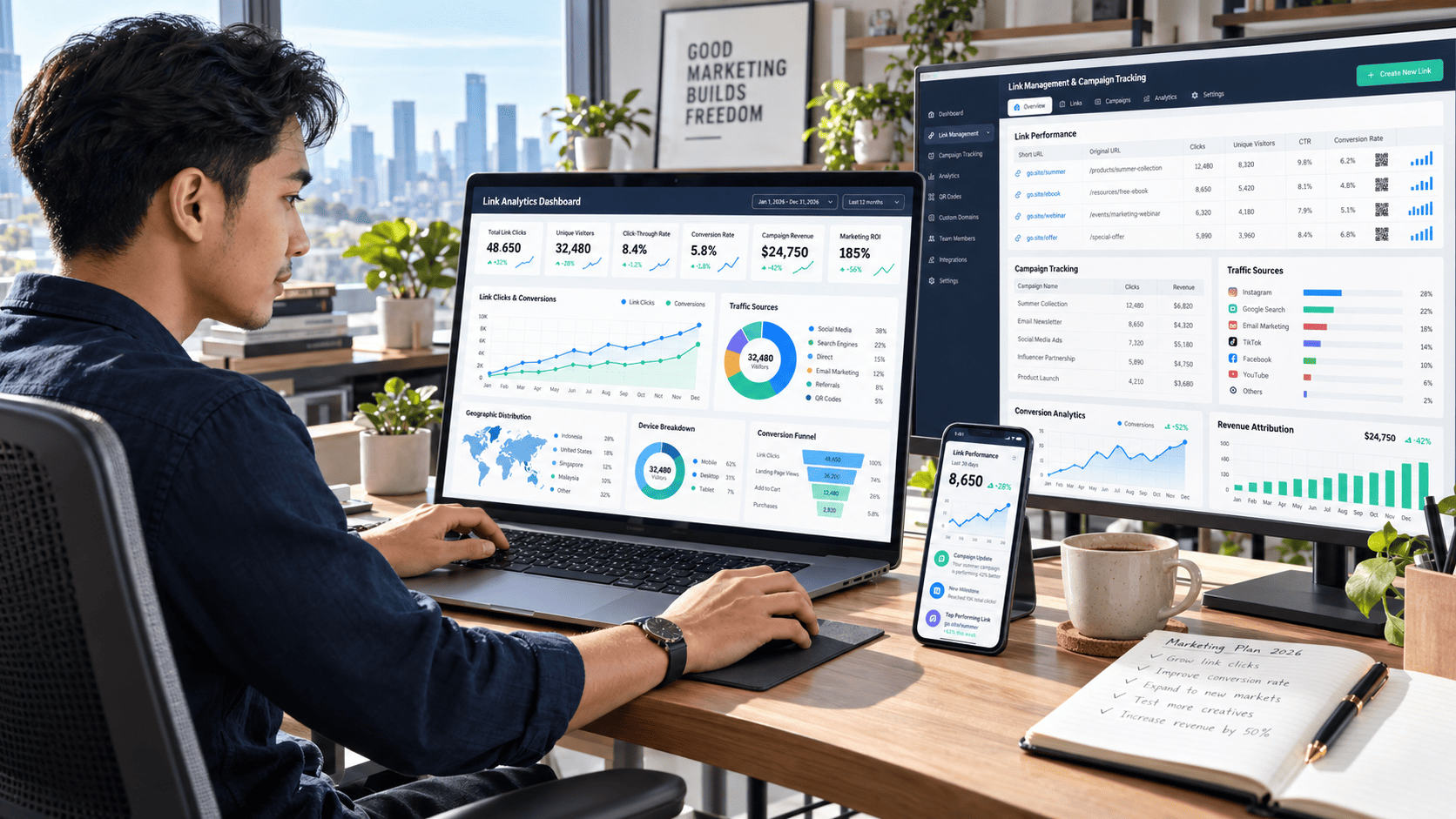
Every click tells a story. Someone saw your social post, opened an email, scanned a QR code, clicked an affiliate recommendation, or discovered your website through another channel. The problem is that without proper link management and analytics, most of those stories remain invisible.
You may know that a campaign generated 10,000 clicks, but where did those clicks come from? Which link produced the most conversions? Were visitors using mobile devices or desktops? Did traffic from email perform better than social media? And perhaps most importantly, which campaigns actually generated meaningful results?
Effective link management turns scattered URLs into measurable marketing assets. Instead of guessing what works, you can track user behavior, compare campaigns, uncover valuable audience insights, and make smarter decisions based on real data.
Here are 15 practical strategies that can help you track every important click and turn your link analytics into better marketing performance.
1. Create a Centralized Link Management System
Managing links becomes messy surprisingly quickly.
A marketer may have dozens of URLs across social media posts, newsletters, advertisements, landing pages, influencer campaigns, and affiliate promotions. When links are stored randomly in spreadsheets, notes, and chat messages, tracking performance becomes difficult.
A centralized link management system keeps everything organized.
Group links based on:
- Campaign
- Traffic source
- Product
- Content type
- Audience
- Marketing channel
For example, instead of mixing Black Friday email links with Instagram campaigns, create separate folders for each campaign.
Better organization makes analytics easier to understand and prevents teams from accidentally using outdated URLs.
2. Use UTM Parameters Consistently
UTM parameters are one of the simplest ways to understand where your visitors come from.
A typical tracked URL may include parameters such as:
utm_source, utm_medium, utm_campaign, utm_content, and utm_term.
Imagine you promote the same landing page through Facebook, email, and a newsletter partnership.
Without UTM tracking, all three channels may appear as general referral traffic. With structured UTM parameters, you can identify exactly which source generated each visit.
Create a Naming Convention
Consistency matters.
Avoid mixing names such as:
- fb
- facebook-social
Analytics platforms may interpret them as separate sources.
Instead, establish clear naming rules across your campaigns. This small habit can dramatically improve reporting accuracy.
3. Track More Than Total Clicks
Total clicks look impressive, but they rarely tell the complete story.
Suppose Link A receives 5,000 clicks and Link B receives only 2,000.
At first glance, Link A appears to be the winner.
But imagine Link A generates 50 conversions while Link B generates 160.
Suddenly, the smaller campaign becomes far more interesting.
Useful metrics include:
- Unique visitors
- Click-through rate
- Conversion rate
- Revenue per visitor
- Engagement
- Bounce behavior
- Returning visitors
Successful link analytics focuses on outcomes, not vanity metrics.
4. Separate Unique Clicks From Total Clicks
One visitor may click the same link several times.
That means 10,000 clicks do not necessarily represent 10,000 people.
Tracking unique visitors helps you estimate your actual audience size while total clicks reveal overall interaction volume.
Comparing both metrics can also reveal interesting behavior. If total clicks are significantly higher than unique clicks, users may be returning to the link repeatedly.
That could indicate strong interest—or confusion that deserves investigation.
5. Analyze Traffic Sources
Knowing where your clicks originate helps you invest resources more intelligently.
Traffic might come from:
- Organic search
- Social media
- Paid advertising
- Affiliate partners
- QR codes
- Referral websites
- Direct visits
Imagine your social campaign generates huge traffic but very few purchases, while email produces fewer clicks but a much stronger conversion rate.
Instead of simply chasing more social traffic, you might decide to strengthen your email strategy.
That is the advantage of combining link management and analytics with business goals.
6. Track Conversion Paths
A click is usually only the beginning of the journey.
Visitors may move through several stages:
Link → Landing Page → Product Page → Checkout → Purchase
Tracking this path helps reveal where users abandon the process.
If 5,000 people visit your landing page but only 500 reach your product page, the problem may not be your traffic source. Your landing page could be causing friction.
Conversion-path analytics helps separate traffic problems from website problems.
7. Segment Analytics by Device
Mobile and desktop visitors often behave differently.
Someone clicking a link from Instagram will probably arrive through a smartphone, while business newsletter subscribers may be more likely to use desktop computers.
Monitor performance across:
- Mobile
- Desktop
- Tablet
- Operating systems
- Browsers
If mobile traffic accounts for 70% of clicks but only 25% of conversions, investigate the mobile experience.
Slow loading pages, complicated forms, intrusive pop-ups, or difficult navigation can quietly destroy conversion rates.
8. Explore Geographic Click Data
Location data can uncover opportunities that basic click counts cannot.
Suppose you run an international campaign expecting most visitors from the United States. Your analytics unexpectedly show significant engagement from Canada and Australia.
That insight could influence:
- Content localization
- Advertising campaigns
- Pricing
- Promotion schedules
- Shipping strategies
- Landing page messaging
Geographic analytics turns unexpected traffic patterns into potential growth opportunities.
9. Compare Campaign Performance Side by Side
Looking at individual campaigns is useful. Comparing them is even more powerful.
Create a simple performance framework containing metrics such as:
| Campaign | Clicks | CTR | Conversions | Conversion Rate |
|---|---|---|---|---|
| Email Launch | 4,200 | 8.4% | 310 | 7.3% |
| Social Campaign | 9,500 | 5.8% | 285 | 3.0% |
| Affiliate Campaign | 3,100 | 6.2% | 260 | 8.4% |
The highest-traffic campaign is not always the most valuable.
Side-by-side comparisons help reveal which channels deserve more attention.
10. Track Individual Content Variations
Sometimes a campaign performs poorly because of the message—not the traffic source.
Create separate tracking links for different:
- Headlines
- Images
- Calls to action
- Videos
- Ad creatives
- Influencers
For example, two social posts may promote the same landing page but use different hooks.
Giving each post a unique tracking link allows you to identify which message attracts higher-quality traffic.
11. Use Link Analytics for A/B Testing
A/B testing becomes much more useful when every variation has its own trackable URL.
Imagine testing two CTA messages:
Version A: Start Your Free Trial
Version B: See How It Works
Both lead to the same destination.
Separate tracking links help measure which CTA produces more clicks and, more importantly, more conversions.
Over time, small improvements across headlines, buttons, placement, and messaging can produce meaningful gains.
12. Monitor Click Patterns Over Time
Analytics should not be viewed only as totals.
Timing matters.
Look at:
- Hourly activity
- Daily performance
- Weekly trends
- Campaign launch periods
- Seasonal behavior
Perhaps your audience clicks email links most frequently between 8:00 and 10:00 a.m. but converts better in the evening.
Those patterns can help improve publishing schedules and campaign timing.
13. Watch for Unusual Traffic Spikes
A sudden surge in clicks sounds exciting, but unusual activity deserves investigation.
Unexpected spikes could result from:
- Viral content
- Influencer mentions
- Successful promotions
- Bots
- Automated crawlers
- Duplicate clicks
- Low-quality traffic
Compare click growth with engagement and conversion metrics.
If clicks suddenly increase by 500% while conversions remain unchanged, the additional traffic may not be valuable.
Healthy analytics asks not only, “How much traffic did we receive?” but also, “What did that traffic actually do?”
14. Connect Link Data With Revenue
Eventually, marketing analytics should connect traffic to business results.
Instead of measuring only:
Campaign → Click
Try measuring:
Campaign → Click → Conversion → Revenue
This gives you a clearer picture of return on investment.
A campaign generating 2,000 clicks and $10,000 in sales may be far more valuable than another campaign producing 20,000 clicks and $3,000 in sales.
Revenue attribution helps teams stop optimizing for attention and start optimizing for results.
15. Turn Analytics Into Regular Optimization
Collecting data is useless if nothing changes afterward.
Build a simple optimization routine.
Weekly Review
Review:
- Top-performing links
- Traffic sources
- Conversion rates
- Unusual activity
- Device performance
Monthly Review
Analyze broader trends, including:
- Best campaigns
- Audience changes
- Geographic growth
- Revenue attribution
- Underperforming channels
Quarterly Review
Use longer-term insights to reconsider budgets, channel priorities, content strategies, and campaign structure.
This creates a continuous cycle:
Track → Analyze → Learn → Optimize → Repeat
That cycle is where link analytics begins creating real competitive value.
How Link Management & Analytics Reveal Hidden Audience Insights
The real power of link analytics goes far beyond counting clicks.
Every interaction can reveal something about your audience.
You may discover that mobile visitors prefer short-form landing pages, email subscribers generate the highest-value customers, visitors from certain countries engage longer, or a particular content format consistently produces higher conversion rates.
These insights allow you to create experiences that better match audience behavior.
Instead of asking, “What should we publish next?” you can ask, “What does our audience data suggest we should publish next?”
That shift from intuition to evidence can significantly improve marketing decisions.
Common Link Management Mistakes to Avoid
Even good marketing campaigns can produce unreliable analytics when tracking is poorly organized.
Common mistakes include:
- Using inconsistent UTM names
- Reusing one tracking link everywhere
- Measuring clicks without conversions
- Ignoring mobile performance
- Mixing campaign naming conventions
- Failing to investigate unusual traffic
- Creating links without clear campaign labels
- Tracking data without regularly reviewing it
The solution does not require complicated technology. Most problems can be prevented through consistent tracking standards and regular analysis.
Conclusion: Turn Every Click Into Actionable Insight
Strong link management and analytics transforms ordinary URLs into valuable sources of marketing intelligence.
Instead of seeing clicks as isolated numbers, you can understand where visitors come from, which devices they use, how they interact with campaigns, what content attracts them, and which journeys ultimately produce conversions.
The most effective approach combines organized link management, consistent UTM tracking, conversion measurement, audience segmentation, campaign comparisons, and regular optimization.
You do not need to implement all 15 strategies overnight. Start by organizing your existing links, standardizing tracking parameters, and identifying the metrics that matter most to your goals. Then gradually improve your analytics process as more data becomes available.
Every click already contains information. The advantage comes from knowing how to capture it, understand it, and turn it into smarter decisions.
Start tracking your most important campaigns today, compare what actually drives results, and use those insights to make your next campaign better than the last.