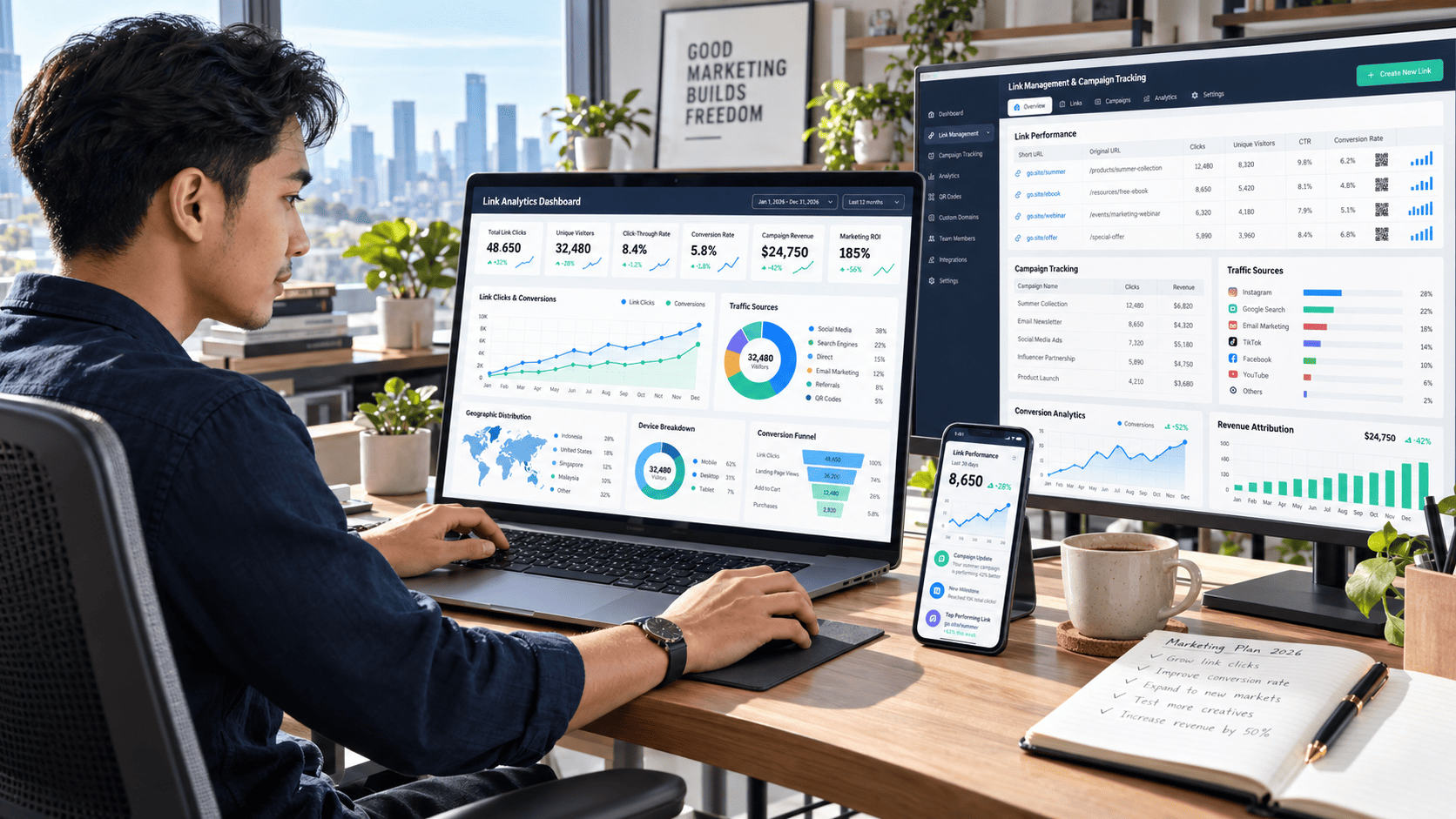
Running a small business means making every marketing dollar count. Whether you're promoting products through social media, sending email newsletters, or running online advertisements, understanding how customers interact with your links is essential. Without reliable tracking, even successful marketing campaigns can leave you wondering which activities actually generate results.
That's where the best link analytics software for small businesses makes a difference. These tools help you monitor link clicks, identify traffic sources, understand audience behavior, and measure campaign performance without requiring advanced technical knowledge.
Imagine discovering that your Instagram campaign generates hundreds of clicks but very few sales, while a simple email newsletter consistently attracts paying customers. With accurate link analytics, you can identify these patterns and invest your marketing budget more effectively.
In this guide, you'll discover some of the most useful link analytics platforms in 2026, their key features, and practical strategies for choosing software that supports sustainable business growth.
What Is Link Analytics Software?
Link analytics software is a digital marketing tool that tracks and analyzes interactions with URLs shared across different marketing channels.
Instead of simply counting website visitors, link tracking tools provide insights into how people engage with individual links.
Depending on the platform, businesses can monitor:
Total link clicks: The number of times users interact with a specific URL.
Unique visitors: Estimated individual users accessing a tracked link.
Traffic sources: Websites, social networks, or campaigns generating visitors.
Geographic locations: Countries or regions where clicks originate.
Device information: Whether visitors use smartphones, tablets, or desktop computers.
Conversion performance: Leads, purchases, or other valuable actions attributed to campaigns.
Campaign engagement: Performance comparisons across different promotional activities.
These insights make it easier to understand which marketing strategies attract attention and which ones contribute to business objectives.
For small businesses with limited resources, this information is particularly valuable because it reduces guesswork when making marketing decisions.
Why Small Businesses Need Link Analytics Software
Many entrepreneurs focus heavily on generating website traffic. However, attracting visitors is only part of building a successful online business.
The real challenge is understanding what happens after someone clicks a promotional link.
Improve Marketing Budget Efficiency
Small businesses rarely have unlimited advertising budgets. Every campaign should contribute to measurable objectives.
Link analytics helps identify which promotional channels deliver meaningful engagement.
For example, a business might discover that a paid advertisement generates 1,000 clicks, while an email campaign produces only 300 clicks but significantly more purchases.
This information helps prioritize campaigns based on business outcomes rather than traffic volume alone.
Understand Customer Behavior
Different audiences respond to different messages, platforms, and promotional offers.
By examining device usage, geographic trends, and referring websites, businesses can improve their targeting strategies.
A local restaurant, for example, might discover that most promotional link clicks come from mobile users during evening hours.
That insight could influence when the restaurant publishes special offers.
Measure Marketing Campaign Performance
Without proper tracking, comparing promotional activities becomes difficult.
Link analytics provides a consistent way to evaluate campaigns across newsletters, social media posts, advertisements, and partnerships.
When combined with website conversion tracking, these insights create a clearer picture of marketing effectiveness.
Best Link Analytics Software for Small Businesses
Several platforms offer useful link management and analytics capabilities. The right choice depends on your budget, technical experience, and tracking requirements.
1. Bitly – Best for Simple Link Tracking
Bitly is a well-known link management platform that combines URL shortening, branded links, QR codes, and engagement analytics.
Its accessible interface makes it particularly attractive for small businesses that want to monitor marketing links without complicated configuration.
Key features include:
Shortened and branded URLs.
Link click and QR code scan tracking.
Geographic and device analytics.
Campaign engagement dashboards.
UTM parameter support.
Reporting and export capabilities on eligible plans.
Bitly is useful for social media managers, online stores, and businesses running promotional campaigns across multiple channels.
For example, a boutique clothing store could create separate tracking links for Instagram promotions, email newsletters, and seasonal sales.
Comparing their performance would reveal which channels generate the strongest initial engagement.
Some analytics features and historical reporting limits depend on the subscription plan.
2. Rebrandly – Best for Branded Links
Rebrandly focuses on branded link management, allowing businesses to use custom domains instead of generic shortened URLs.
This makes it appealing to companies that want consistent brand presentation throughout their marketing activities.
Its capabilities include branded URLs, automatic UTM parameters, editable destinations, link expiration settings, and traffic routing options.
For example, a consulting business might share a link such as go.example.com/consultation rather than a long promotional URL.
A recognizable domain can make marketing materials look more professional and easier to remember.
Rebrandly is especially suitable for businesses that prioritize brand identity alongside campaign tracking.
3. Dub – Best for Conversion Attribution
Dub is a modern link management and analytics platform designed to connect marketing engagement with measurable business outcomes.
Unlike tools focused primarily on click counts, Dub emphasizes understanding the relationship between link interactions, leads, and revenue.
Its notable capabilities include real-time analytics, geographic and device breakdowns, conversion tracking, customer insights, shared dashboards, and integrations.
For example, a subscription-based business could use Dub to understand which referral campaigns contribute to customer signups and paid subscriptions.
This makes the platform particularly interesting for SaaS companies, online service providers, and businesses with performance-focused marketing strategies.
Conversion attribution requires appropriate tracking configuration and integrations, so businesses should evaluate implementation requirements before committing.
4. Short.io – Best for Custom Domains and Detailed Analytics
Short.io combines custom-domain link shortening with detailed analytics and advanced link management features.
It supports businesses that want flexible control over links while retaining access to useful engagement data.
Important capabilities include:
Branded short links using custom domains.
Click tracking and reporting.
Browser, operating system, and device breakdowns.
Geographic and referral analytics.
Campaign tracking and integrations.
API access for automated workflows.
A small digital agency could use separate branded domains to organize links for different clients while reviewing their campaign performance.
Short.io also offers a free plan, although analytics availability and usage limits vary by subscription level.
5. Google Analytics 4 – Best for Website Conversion Insights
Google Analytics 4, commonly called GA4, is not primarily a URL shortener. However, it is an important companion tool for businesses that want to understand what happens after visitors arrive on their websites.
Using UTM-tagged campaign links, businesses can analyze traffic acquisition, user engagement, and configured conversion-related events.
For example, a local service provider could use tracked newsletter links to understand how email visitors behave after reaching a booking page.
GA4 is particularly valuable when combined with a dedicated link tracking platform.
The link tracking tool measures initial engagement, while GA4 adds website behavior and business outcome insights.
Google documents the use of UTM parameters for identifying marketing campaigns in acquisition reports.
Best Link Analytics Software Comparison
| Software | Best for | Main strength |
|---|---|---|
| Bitly | Beginners and small teams | Simple link and QR analytics |
| Rebrandly | Brand-focused businesses | Custom branded URLs |
| Dub | Performance marketers | Conversion and revenue attribution |
| Short.io | Agencies and growing teams | Custom domains and detailed tracking |
| Google Analytics 4 | Website owners | Traffic and conversion analysis |
Each platform offers a different balance of simplicity, customization, and analytical depth.
Rather than choosing software based solely on popularity, businesses should identify the measurements that matter most to their marketing goals.
How to Choose the Best Link Analytics Software
Selecting the right platform involves more than comparing feature lists.
A practical approach is to evaluate five important factors.
1. Ease of Use
Small business owners often manage several responsibilities simultaneously.
Choose software with an intuitive dashboard, straightforward link creation, and reports that are easy to interpret.
A complicated platform can become an unnecessary burden if basic campaign tracking requires extensive setup.
2. Analytics Capabilities
Consider whether the platform provides the information required for your marketing decisions.
Basic click tracking may be sufficient for content promotion, while online stores might require conversion tracking and revenue attribution.
3. Pricing and Scalability
Free plans can be helpful when testing a platform.
However, check limitations involving monthly clicks, branded domains, analytics history, team members, and data exports.
A tool that works for a small campaign may become restrictive as your marketing activity grows.
4. Integration Options
Software that connects with existing marketing tools can reduce manual reporting.
Useful integrations may include Google Analytics, advertising platforms, automation services, and customer relationship management systems.
5. Privacy and Data Reliability
Reliable analytics depends on accurate measurement and responsible data handling.
Consider how each platform processes visitor information, filters automated traffic, and supports applicable privacy requirements.
Also remember that browser restrictions, consent settings, and tracking protection may affect reported results.
How to Use Link Analytics to Improve Marketing Results
Installing analytics software is only the beginning. The greatest value comes from turning data into actionable improvements.
Step 1: Define Clear Campaign Goals
Every campaign should have a measurable objective.
Common examples include generating website visits, collecting leads, increasing product purchases, or encouraging newsletter registrations.
A campaign focused on sales should not be evaluated exclusively through click counts.
Step 2: Create Unique Tracking Links
Use separate links for different marketing channels and promotional materials.
For example, a business promoting a seasonal sale could create distinct links for Instagram, Facebook, newsletters, and partner websites.
This approach helps identify which placements produce engagement.
Step 3: Add UTM Parameters
UTM parameters identify how campaign traffic reaches a website.
A basic example looks like this:
https://example.com/sale?utm_source=newsletter&utm_medium=email&utm_campaign=october_sale
In this example, the source identifies the newsletter, the medium represents email marketing, and the campaign identifies the promotion.
Consistent naming improves reporting accuracy and prevents related campaigns from appearing as unrelated entries.
Step 4: Analyze Engagement and Conversions
Review performance regularly instead of checking click totals without context.
Suppose a campaign produces the following hypothetical results:
| Metric | Campaign A | Campaign B |
|---|---|---|
| Clicks | 1,200 | 650 |
| Purchases | 24 | 39 |
| Purchase rate | 2% | 6% |
Campaign A attracts more visitors, but Campaign B converts a larger percentage into customers.
If both campaigns have comparable costs and order values, Campaign B may represent the stronger marketing opportunity.
Step 5: Optimize Based on Results
Use your findings to improve campaign performance.
Test different headlines, calls to action, publishing times, landing pages, and promotional channels.
Change one important variable at a time whenever possible so that performance differences are easier to interpret.
Over time, these small improvements can produce more efficient marketing campaigns.
Common Link Analytics Mistakes to Avoid
Even powerful software cannot compensate for poor measurement practices.
One common mistake is treating every click as a potential customer. Some visits may come from bots, automated link previews, repeated interactions, or visitors without purchase intent.
Another mistake is using inconsistent campaign names. Labels such as Facebook, facebook, and FB can complicate reporting and make comparison more difficult.
Businesses should also avoid focusing exclusively on short-term results.
A marketing campaign may generate relatively few immediate purchases while introducing new customers who convert later.
Finally, link clicks and website sessions should not be expected to match perfectly. Tracking restrictions, page-loading failures, and measurement differences can create discrepancies between platforms.
Understanding these limitations leads to more realistic conclusions.
Frequently Asked Questions About Link Analytics Software
What is the best free link analytics software for small businesses?
Short.io offers a free plan with branded link and analytics capabilities, while Google Analytics 4 provides valuable website traffic measurement. The best starting point depends on whether the business primarily needs link engagement data or website behavior insights.
Can link analytics software track sales?
Yes, certain platforms support conversion and revenue attribution. However, sales measurement typically requires additional integration with website events, payment systems, or other business tools.
Is link analytics different from website analytics?
Yes. Link analytics measures interactions with tracked URLs, while website analytics focuses on visitor behavior after someone reaches a website. Using both can provide a more complete understanding of campaign performance.
Do small businesses need paid link tracking tools?
Not always. Businesses running a limited number of campaigns may find free tools sufficient. Paid plans become more useful when advanced reporting, collaboration, branded domains, or higher tracking limits are necessary.
Conclusion
Choosing the best link analytics software for small businesses can transform how marketing decisions are made.
Bitly offers approachable link tracking, Rebrandly emphasizes branded URLs, Dub provides advanced attribution capabilities, and Short.io combines flexible link management with detailed analytics. Google Analytics 4 complements these platforms by revealing how campaign visitors interact with your website.
The most important consideration is not how many features a platform offers, but whether its insights help your business make better decisions.
Start with a tool that matches your current needs, create consistent tracking links, and review campaign results regularly. As your business grows, expand your analytics capabilities to understand conversions, customer behavior, and marketing profitability.
Ready to improve your marketing performance? Explore one of these link analytics platforms, track your next promotional campaign, and use the results to make smarter decisions that support long-term business growth.