Have you ever wondered why some marketing links generate hundreds of clicks but barely any sales? You're attracting visitors, sharing valuable content, and promoting your offers, yet your conversion numbers remain disappointing. The problem might not be your marketing strategy. It could be how you're tracking and analyzing your links.
Understanding link analytics secrets to boost conversions can completely change how you approach digital marketing. Instead of guessing which campaigns work, you can identify exactly where visitors come from, what captures their attention, and which links encourage meaningful actions.
Whether you're a blogger, affiliate marketer, business owner, or digital marketing professional, learning to interpret link performance data helps you make smarter decisions, reduce wasted spending, and turn ordinary clicks into valuable conversions.
Let's explore the practical strategies that make link analytics a powerful tool for sustainable marketing growth.
What Is Link Analytics and Why Does It Matter?
Link analytics is the process of tracking, measuring, and evaluating how people interact with links across websites, social media platforms, email campaigns, and digital advertisements.
Unlike basic traffic monitoring, link analytics provides detailed insights into individual marketing links and their performance.
Common link analytics metrics include:
- Total clicks: The number of times users click a particular link.
- Unique clicks: An estimate of individual users interacting with a link.
- Click-through rate (CTR): The percentage of impressions that result in clicks.
- Conversion rate: The percentage of visitors completing a desired action.
- Traffic sources: The channels responsible for generating visits.
- Geographic location: The countries or regions associated with visitors.
- Device breakdown: Whether visitors use smartphones, tablets, or computers.
These insights help marketers distinguish between traffic that simply looks impressive and traffic that actually contributes to business goals.
For example, imagine an online store promoting the same product through Instagram, email newsletters, and blog articles.
Instagram generates 2,000 visitors, while email generates only 500. At first glance, Instagram seems more successful.
However, if Instagram produces 20 purchases and email produces 30, the email campaign has a significantly higher conversion rate.
Without link analytics, that valuable difference could easily go unnoticed.
1. Track Every Marketing Campaign With UTM Parameters
One of the most effective link analytics strategies involves using UTM parameters.
UTM parameters are tracking tags added to URLs to help analytics platforms identify where visitors originate.
How UTM Tracking Works
A typical tracking URL looks like this:
https://example.com/product?utm_source=facebook&utm_medium=social&utm_campaign=summer_sale
This URL contains three important tracking elements:
- utm_source: Identifies the traffic source, such as Facebook or Google.
- utm_medium: Defines the marketing channel, such as email or paid social.
- utm_campaign: Identifies the promotional campaign.
Additional parameters, including utm_content and utm_term, support more detailed tracking.
Why Consistent UTM Naming Matters
Inconsistent naming conventions can create confusing analytics reports.
For example, using Facebook, facebook, and fb for the same source may fragment campaign data.
Develop a consistent naming structure across your marketing activities. This makes comparing performance easier and reduces reporting errors.
With properly configured analytics, UTM tracking reveals which campaigns attract engaged visitors and which deserve further optimization.
2. Focus on Conversion Rate Instead of Click Volume
Many marketers celebrate increasing click numbers without evaluating what happens afterward.
However, clicks alone do not guarantee business growth.
Understanding Link Conversion Rate
Conversion rate measures the percentage of visitors who complete a specific goal.
The formula is straightforward:
Conversion Rate = (Conversions ÷ Visitors) × 100
Suppose two campaigns produce these results:
| Metric | Campaign A | Campaign B |
|---|---|---|
| Visitors | 5,000 | 2,000 |
| Conversions | 50 | 80 |
| Conversion Rate | 1% | 4% |
Although Campaign A attracts more traffic, Campaign B converts visitors four times as effectively.
This illustrates why conversion-focused analytics matters more than chasing impressive traffic totals.
Identify High-Intent Traffic
High-intent visitors are more likely to complete meaningful actions because their needs closely match your offer.
For instance, someone searching for "best email marketing software for small businesses" may be closer to making a purchase than someone casually browsing general marketing tips.
Analyzing conversion rates by traffic source helps you prioritize audiences with stronger buying intent.
3. Use Link Analytics to Understand Audience Behavior
Every click provides information about your audience.
By examining patterns across campaigns, you can discover what motivates visitors and where their interests differ.
Analyze Traffic by Device
Mobile visitors often behave differently from desktop users.
A campaign might generate substantial smartphone traffic but experience weak conversions because its landing page loads slowly or its checkout process is difficult to navigate.
Reviewing device-level conversion performance can reveal these issues.
Practical improvements include simplifying forms, improving mobile navigation, and ensuring buttons remain easy to tap.
Study Geographic Performance
Geographic analytics can identify regions where your marketing messages resonate most effectively.
For example, an international e-commerce campaign may receive similar traffic volumes from two countries but produce significantly different purchase rates.
Potential explanations include pricing, payment options, language preferences, and shipping availability.
These insights support more relevant localization and audience targeting.
4. Improve Landing Pages Using Link Performance Data
Getting someone to click is only the beginning.
The landing page must deliver the experience visitors expect.
If your advertisement promises a free marketing checklist but the destination page promotes an unrelated paid service, visitors may leave without converting.
Match Your Message With Visitor Expectations
Strong landing pages maintain consistency between the original link and the destination.
Focus on three essential elements:
- Clear headlines: Immediately communicate the value visitors will receive.
- Relevant content: Address the specific problem that motivated the click.
- Visible calls to action: Make the next step obvious and convenient.
Identify Conversion Friction
Conversion friction refers to obstacles preventing visitors from taking action.
Common examples include complicated registration forms, distracting page layouts, unexpected fees, and slow-loading pages.
Compare landing-page engagement and conversion data across campaigns to identify where improvements may have the greatest impact.
Even small usability changes can produce meaningful results when supported by reliable analytics.
5. Discover Winning Links Through A/B Testing
A/B testing allows marketers to compare two variations of a marketing element and determine which performs better.
Instead of relying on assumptions, you make decisions using measurable results.
What Should You Test?
Useful elements to experiment with include:
- Call-to-action wording
- Link placement within articles
- Button design and visibility
- Promotional headlines
- Landing-page layouts
- Email subject lines
For example, a newsletter might compare two calls to action:
Version A: "Learn More"
Version B: "Explore the Free Marketing Guide"
By directing comparable audiences to each version and measuring conversion outcomes, marketers can determine which message performs better.
Avoid Misleading Test Results
A winning variation should not be selected simply because it generates a few additional clicks.
Evaluate the sample size, test duration, and conversion results before reaching conclusions.
Change one primary element at a time when possible, and account for random variation before declaring a winner.
Reliable testing creates a continuous improvement process rather than a cycle of unnecessary design changes.
6. Segment Your Link Analytics for Better Insights
Aggregated analytics can hide important performance differences.
Segmentation solves this problem by dividing your data into meaningful groups.
For example, you can compare conversions based on:
- Traffic source
- Marketing campaign
- Device category
- Geographic region
- New versus returning visitors
- Individual landing pages
Imagine an affiliate marketing campaign with an overall conversion rate of 2%.
Further analysis reveals that returning desktop visitors convert at 5%, while first-time mobile visitors convert at just 0.8%.
These differences suggest distinct optimization opportunities.
Returning visitors may respond well to personalized offers, while mobile visitors may benefit from simpler navigation and clearer product information.
Segmentation transforms broad statistics into actionable marketing insights.
7. Connect Link Analytics With Revenue Tracking
One of the most valuable link analytics secrets is connecting clicks with actual business outcomes.
A campaign generating affordable traffic is not necessarily profitable.
Understanding financial performance requires tracking conversions, revenue, and marketing expenses together.
Measure Return on Investment
Return on investment helps evaluate whether marketing activities generate more value than they cost.
A simplified marketing ROI calculation is:
ROI = ((Revenue − Campaign Cost) ÷ Campaign Cost) × 100
Suppose a campaign costs $500 and generates $1,500 in attributed revenue.
Its simplified revenue-based ROI is 200%.
However, a complete profitability analysis should also consider product costs, transaction fees, and other relevant expenses.
Identify Your Most Valuable Marketing Channels
Connect link tracking with appropriate conversion events and revenue data.
This allows you to compare campaigns based on meaningful outcomes rather than surface-level engagement.
For subscription businesses, measuring customer lifetime value can provide additional context because the initial purchase may represent only part of a customer's total value.
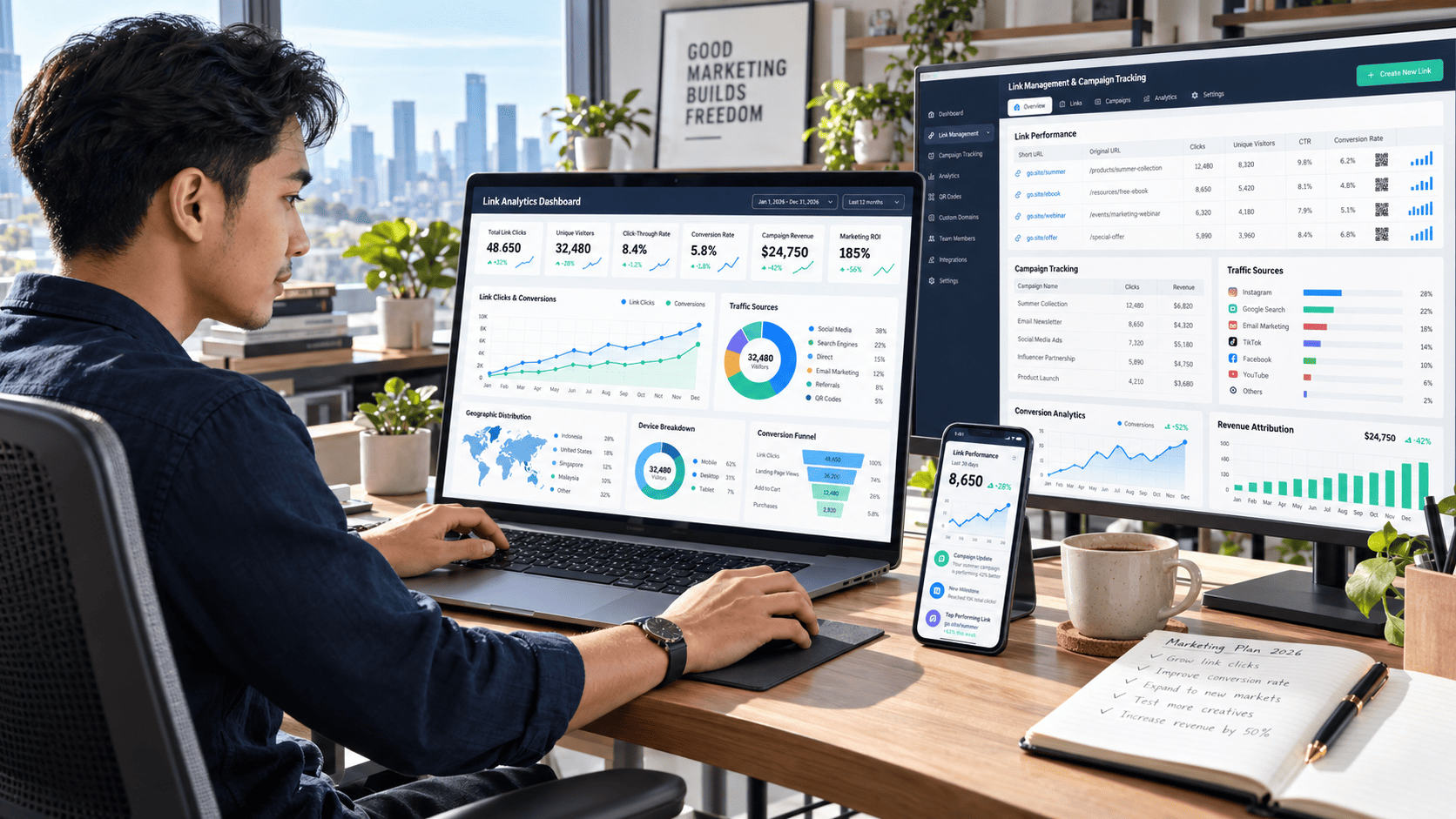
8. Build a Simple Link Analytics Dashboard
A well-organized dashboard makes it easier to monitor performance without constantly switching between reports.
Popular solutions include Google Analytics, dedicated link management platforms, and dashboard visualization tools.
Essential Dashboard Metrics
A practical dashboard should display:
| Metric | Purpose |
|---|---|
| Total Clicks | Monitor link engagement |
| Unique Clicks | Estimate individual reach |
| CTR | Evaluate promotional effectiveness |
| Conversion Rate | Measure goal completion |
| Traffic Sources | Identify valuable channels |
| Revenue | Track financial outcomes |
| Campaign Cost | Evaluate spending efficiency |
Organize your dashboard around the metrics that directly support your business objectives.
Review Performance Regularly
Daily monitoring can help detect unexpected changes, while weekly and monthly reviews reveal broader trends.
Look for unusual traffic spikes, declining conversion rates, underperforming campaigns, and emerging high-value channels.
Also verify your analytics implementation and consent settings. Browser restrictions, ad blockers, and privacy preferences can affect tracking completeness.
Accurate interpretation is just as important as accurate data collection.
9. Avoid Common Link Analytics Mistakes
Even experienced marketers can misinterpret analytics data.
Several mistakes frequently limit the effectiveness of link tracking.
Tracking Clicks Without Conversion Events
Click statistics provide limited value when you cannot connect them to meaningful outcomes.
Configure appropriate conversion events, such as purchases, completed registrations, or qualified leads.
Using Inconsistent Campaign Names
Inconsistent UTM naming produces fragmented reports and makes comparisons unnecessarily difficult.
Maintain standardized campaign naming conventions.
Ignoring Invalid or Automated Traffic
Not every recorded click represents genuine human interest.
Bots, repeated automated requests, and accidental interactions may inflate engagement metrics.
Use appropriate filtering, traffic quality checks, and analytics validation to reduce misleading conclusions.
Confusing Correlation With Causation
A campaign with strong conversion performance may benefit from seasonal demand, audience differences, or existing customer relationships.
Use controlled experiments where practical before assuming that a single marketing change caused an improvement.
10. Turn Link Analytics Insights Into Continuous Growth
The real advantage of link analytics comes from acting on the information you collect.
Successful marketers establish a repeatable optimization cycle.
First, identify a measurable business objective, such as increasing newsletter registrations or product purchases.
Next, track relevant links and conversion events using consistent campaign parameters.
Analyze performance to discover which sources and landing pages generate meaningful results.
Then test targeted improvements, measure the outcomes, and apply successful changes.
Over time, this process helps allocate marketing resources more effectively and reduces dependence on guesswork.
Remember that link analytics works best when combined with valuable content, relevant offers, and a positive user experience.
Technology can reveal opportunities, but thoughtful marketing decisions turn those opportunities into results.
Conclusion: Use Link Analytics to Boost Conversions
Understanding proven link analytics secrets to boost conversions gives you a clearer picture of how your marketing efforts influence customer behavior.
From UTM tracking and audience segmentation to conversion analysis, A/B testing, and revenue measurement, each strategy helps transform ordinary link data into practical business intelligence.
The most important lesson is simple: successful digital marketing is not about attracting the highest number of clicks. It is about attracting the right visitors and helping them take meaningful action.
Start by reviewing your existing marketing links, identifying your strongest traffic sources, and improving one underperforming campaign. Measure the results, learn from the data, and continue optimizing.
Ready to turn more clicks into real conversions? Start tracking your links more strategically today, share these insights with your marketing team, and make data-driven optimization part of your everyday marketing routine.