Someone discovers your content, taps a link, visits a landing page, explores an offer, and either takes action or disappears. The problem is that many marketers, creators, bloggers, and online businesses only see the final traffic number. They know people clicked, but they do not always know where those visitors came from, what caught their attention, or why some converted while others left.
That is where smart link management and analytics become valuable.
Instead of treating links as simple paths from one page to another, you can turn them into measurable marketing assets. With the right tracking structure, campaign tags, audience insights, and performance analysis, every link can help you understand what your audience actually wants.
And once you understand that behavior, improving conversions becomes far easier.
What Is Link Management & Analytics?
Link management is the process of organizing, tracking, maintaining, and optimizing the links you use across websites, social media, emails, advertisements, affiliate campaigns, and other digital channels.
Link analytics adds the measurement layer.
It helps reveal details such as:
- How many people clicked a link
- Which campaign generated the click
- Which traffic source performed best
- Which device visitors used
- Where visitors came from
- When engagement was highest
- Which landing pages generated conversions
- Which campaigns produced traffic but little business value
Together, link management and analytics give you something more useful than raw traffic: context.
Imagine two campaigns each generating 5,000 clicks. At first glance, they look equally successful.
But deeper analysis may reveal that Campaign A generates 250 purchases while Campaign B generates only 20.
Without proper tracking, you might continue investing equally in both. With reliable analytics, the smarter decision becomes obvious.
Why Tracking Every Click Matters
Traffic alone does not guarantee growth.
A website can receive thousands of visitors while generating very few leads, subscribers, or sales. The real question is not simply, "How much traffic did we get?"
The better question is:
What happened after the click?
Traffic Quality Matters More Than Raw Volume
Suppose a blog post receives 10,000 visitors from a viral social post. Another article receives only 2,000 visitors from organic search.
The viral post may look more successful.
However, if search visitors spend more time reading, subscribe to the newsletter, visit product pages, and eventually purchase, that smaller traffic source may be far more valuable.
Link analytics helps uncover that difference.
It allows marketers to evaluate traffic based on intent and outcomes rather than impressive-looking click numbers.
Attribution Becomes Much Clearer
Modern users rarely interact with a brand only once.
A typical journey might look like this:
Social post → Blog article → Email subscription → Promotional email → Product page → Purchase
Without structured link tracking, the final conversion may appear disconnected from the original campaign.
When your links are properly tagged and organized, you can start seeing how different channels contribute to the customer journey.
Build a Clean Link Management System First
Good analytics starts with good organization.
If links are created randomly, tracking quickly becomes messy. Campaign names become inconsistent, duplicate URLs appear everywhere, and reports become difficult to interpret.
A simple structure solves much of this problem.
Create Consistent Naming Conventions
Campaign naming should be predictable.
Instead of using random names like:
- campaign1
- testnew
- promo-final
- social2
Use descriptive structures such as:
- summer-product-launch
- newsletter-september
- instagram-product-demo
- blog-seo-guide
The goal is simple: anyone reviewing the analytics later should understand what the campaign represents.
Keep Your Links Organized by Channel
Separate links based on where they are used.
For example:
- Social media campaigns
- Email campaigns
- Paid advertising
- Blog content
- Affiliate promotions
- Influencer campaigns
- Partnerships
- Landing page tests
This structure makes comparison easier when evaluating performance.
Use UTM Parameters to Understand Traffic Sources
UTM parameters are one of the simplest ways to improve campaign tracking.
They attach additional information to a URL so analytics platforms can identify where traffic originated.
Common UTM fields include:
- utm_source — where visitors came from
- utm_medium — the marketing channel
- utm_campaign — the specific campaign
- utm_content — different creative or link variations
- utm_term — often used for keywords or paid campaigns
For example, a newsletter link could indicate that the visitor came from an email campaign promoting a specific product launch.
Keep UTM Naming Consistent
Consistency matters more than complexity.
Using several variations such as:
Facebook
facebook
FB
facebook-social
can fragment your reports.
Choose one naming style and use it everywhere.
Lowercase naming is often easier to maintain because it prevents accidental duplicates caused by capitalization.
Measure More Than Total Clicks
Click volume is useful, but it should rarely be the only metric you monitor.
A strong link analytics dashboard should help you understand both engagement and business outcomes.
Important Metrics to Monitor
Total Clicks
Shows overall interaction with a link.
Useful for evaluating reach and interest.
Unique Clicks
Helps estimate how many individual visitors interacted with the link rather than counting repeated clicks from the same person.
Click-Through Rate
Shows how effectively a message, advertisement, email, or call-to-action encourages people to click.
A high click-through rate may indicate strong messaging or creative alignment.
Conversion Rate
This is where link performance becomes much more meaningful.
Conversions might include:
- Product purchases
- Newsletter signups
- Account registrations
- Contact form submissions
- Downloads
- Trial activations
- Bookings
A campaign generating fewer clicks but more conversions can be more valuable than a campaign generating huge traffic with little action.
Decode Audience Behavior After the Click
Link analytics should answer more than where visitors came from.
The next step is understanding what they do after arriving.
Study Landing Page Behavior
Imagine a campaign generates thousands of clicks but very few conversions.
The problem might not be the campaign itself.
Visitors may be interested enough to click, but the landing page may have:
- Slow loading times
- Confusing messaging
- Too many distractions
- Weak calls-to-action
- Poor mobile usability
- A mismatch between the advertisement and the page
Tracking user behavior helps identify where the journey breaks.
Compare Traffic Sources
Different audiences behave differently.
Search visitors may arrive with strong intent because they are actively looking for information.
Social visitors may be more curious but less ready to purchase.
Email subscribers may already know your brand and therefore convert more easily.
Instead of treating all visitors equally, compare performance by source.
You may discover that one channel delivers fewer visitors but produces far better business results.
Track Links Across the Entire Customer Journey
One of the biggest mistakes in digital marketing is focusing only on the first click.
Conversions often happen after several interactions.
A potential customer might discover your brand through social media, read multiple articles, subscribe to your email list, return several days later, and finally purchase.
Smart link management helps connect those interactions.
Think in Funnels
A simple funnel might look like:
- Awareness
- Interest
- Engagement
- Consideration
- Conversion
- Retention
Each stage can contain trackable links.
For example:
Awareness: Social post link
Interest: Blog article link
Engagement: Newsletter signup
Consideration: Product comparison page
Conversion: Checkout page
Retention: Follow-up email
Tracking links throughout this funnel reveals where users drop off and where improvements could create the biggest impact.
Use A/B Testing to Improve Link Performance
Small changes can produce meaningful differences.
A/B testing compares two versions of the same campaign element.
You could test:
- Different call-to-action wording
- Different button placement
- Different images
- Short vs. long copy
- Different landing pages
- Different promotional messages
Create separate tracked links for each variation.
Then compare not only clicks, but also conversions.
For example:
Version A: 1,000 clicks and 20 conversions
Version B: 800 clicks and 40 conversions
Version A attracts more clicks.
Version B produces twice as many conversions.
If you only measured click volume, you might choose the wrong winner.
Avoid Common Link Tracking Mistakes
Even sophisticated analytics become unreliable when tracking is poorly implemented.
Tracking Everything Without a Clear Purpose
Collecting more data does not automatically create better decisions.
Before creating tracking links, decide what question you want to answer.
Examples include:
- Which social platform sends the best traffic?
- Which email campaign generates the most sales?
- Which CTA converts better?
- Which blog articles generate leads?
Clear questions produce useful analytics.
Ignoring Broken or Outdated Links
Links change.
Pages are deleted, campaigns expire, websites migrate, and products disappear.
Regularly review important links to prevent visitors from landing on error pages.
Broken links can damage both user experience and conversion opportunities.
Using Inconsistent Campaign Tags
Poorly structured campaign parameters quickly create messy reports.
Create a simple naming guide and follow it consistently across your team.
Turn Analytics Into Action
Data only becomes valuable when it changes what you do next.
Instead of checking analytics simply to watch numbers rise or fall, build a routine around actionable questions.
Ask:
- Which traffic source creates the most conversions?
- Which campaigns bring high-quality visitors?
- Which links receive clicks but few conversions?
- Which landing pages lose visitors?
- Which content generates repeat engagement?
- Which campaign should receive more budget?
- Which channel should be reduced or improved?
This turns analytics from passive reporting into decision-making.
Use a Simple Optimization Cycle
A practical workflow looks like this:
Track → Analyze → Identify → Test → Improve → Repeat
Track campaign activity.
Analyze what visitors do.
Identify weak or strong points.
Test improvements.
Measure the results.
Then repeat the process.
Over time, even small optimizations can produce significant improvements across traffic quality and conversion performance.
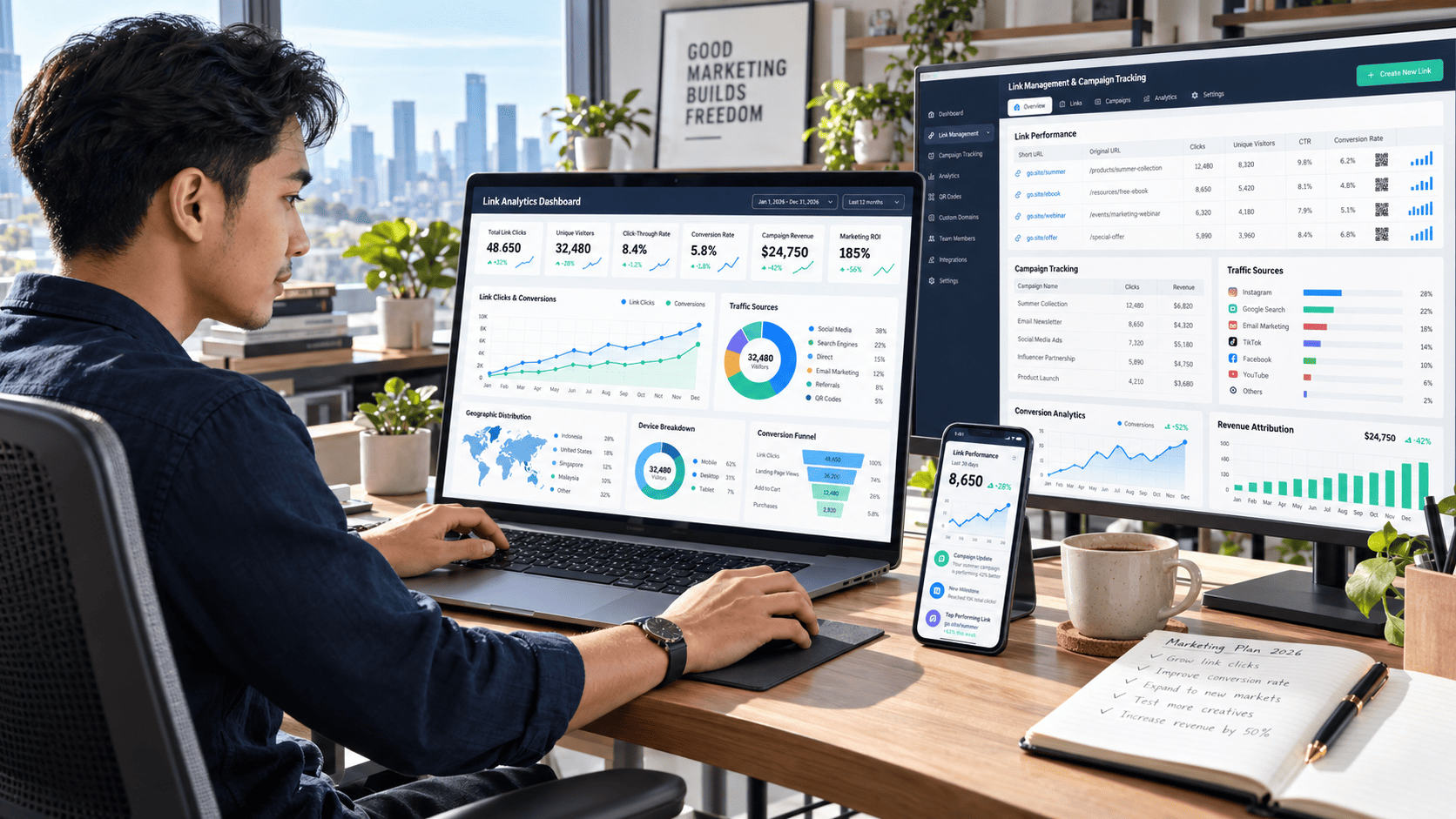
Create a Link Performance Dashboard
When dozens or hundreds of campaigns are running, checking individual links becomes inefficient.
A centralized dashboard makes the process much easier.
Your dashboard could include:
- Total clicks
- Unique clicks
- Traffic sources
- Top-performing campaigns
- Conversion rate
- Device distribution
- Geographic traffic
- Landing page performance
- Revenue by campaign
- Cost per conversion
- Returning visitors
The goal is not to display every possible metric.
Focus on information that helps you make decisions quickly.
A clean dashboard should allow you to understand campaign health within minutes.
Make Link Management Part of Your Growth Strategy
Link management is often treated as a technical task.
In reality, it can influence your entire digital marketing strategy.
Every tracked link provides feedback.
That feedback reveals:
- What topics attract attention
- Which channels generate valuable audiences
- Which offers convert
- Which campaigns waste resources
- Which landing pages need improvement
- Which audiences are most engaged
Over time, those insights make future campaigns smarter.
Instead of guessing what your audience wants, you begin building decisions around real behavior.
Conclusion
Smart link management and analytics transform ordinary links into powerful sources of marketing intelligence.
Tracking every click helps you understand where visitors come from, which campaigns attract the right audience, how users move through your funnel, and where conversions are won or lost.
The most effective approach is not complicated.
Keep links organized, use consistent campaign tracking, monitor meaningful metrics, compare traffic quality, study post-click behavior, and continuously test improvements.
The real advantage comes from connecting those insights to action.
Start by reviewing the links in your most important campaigns today. Clean up inconsistent tracking, identify your strongest traffic sources, and look for places where visitors are dropping out of the journey.
A single click may seem small, but when thousands of clicks are measured properly, they can reveal exactly where your next growth opportunity is hiding.