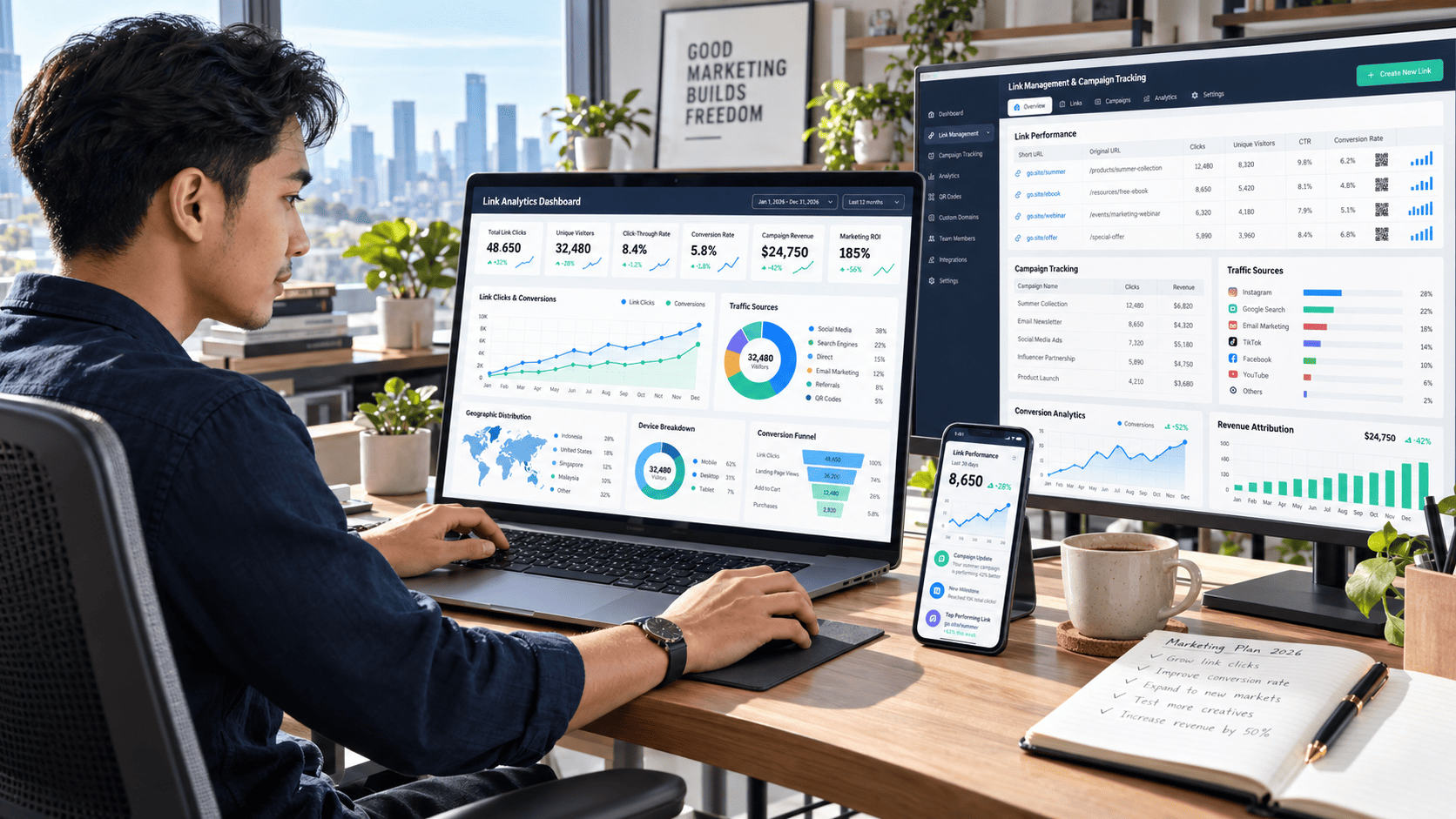
A link may look like one of the simplest parts of digital marketing, but behind every click is valuable information about your audience. Someone may discover your content through social media, open a link from an email, arrive from a blog post, or click an advertisement before finally making a purchase or signing up.
The problem is that many businesses and content creators still treat links as simple pathways rather than measurable marketing assets.
Without proper link management and analytics, you may know how much traffic a campaign generates, but not which channel brings the most valuable visitors, which content creates meaningful engagement, or which link actually contributes to conversions.
A smarter approach changes that.
By organizing, tracking, and analyzing your links properly, you can turn ordinary clicks into useful insights that help you make better marketing decisions, improve campaigns, and ultimately increase conversions.
Why Link Management & Analytics Matters More Than Ever
Modern customers rarely follow a straight path before converting.
A person might discover your brand through a social post, read an article several days later, return through an email campaign, and finally purchase after clicking a promotional link.
Without structured tracking, those interactions can appear disconnected.
Link management creates a clear system for organizing marketing links, while analytics reveals what happens after those links are clicked.
Together, they help answer important questions such as:
- Which campaign attracts the most visitors?
- Which traffic source produces the strongest conversions?
- What content encourages people to take action?
- Which devices are visitors using?
- Where are your most valuable audiences located?
- Which channels generate clicks but fail to convert?
Instead of relying on assumptions, marketers can use real behavioral signals to guide future decisions.
Build a Clear Link Management Structure
Good analytics starts with good organization.
Imagine running campaigns across Facebook, Instagram, email newsletters, paid advertisements, affiliate partnerships, and several blog posts. If every campaign uses random or unorganized links, tracking performance becomes unnecessarily difficult.
A simple naming structure can solve the problem.
For example, links can be categorized according to:
- Campaign
- Traffic source
- Content type
- Audience segment
- Promotion
- Landing page
- Marketing channel
A campaign promoting a new product might have separate tracking links for email, social media, paid ads, and partner websites.
Even if all those links lead to the same landing page, their tracking parameters allow you to compare performance accurately.
Keep Campaign Naming Consistent
Consistency becomes extremely important when campaigns grow.
Suppose one campaign uses labels such as:
facebook
while another uses:
Facebook
and another uses:
fb
Your analytics platform may treat these values as different traffic sources.
Creating simple naming rules prevents fragmented reports and makes long-term analysis much easier.
Track Every Click With Meaningful Parameters
One of the most effective ways to understand campaign performance is through tracking parameters.
UTM parameters, for example, allow marketers to attach additional information to URLs so analytics platforms can identify where visitors came from.
A tracked URL can contain information about:
- Source
- Medium
- Campaign
- Content
- Keyword
Imagine promoting the same landing page through three channels.
One link is shared through an email newsletter, another through social media, and another through a paid advertisement.
Without tracking parameters, those visitors may simply appear as general website traffic.
With structured tracking, you can clearly see which channel generated the clicks and which produced the best results.
Track What Actually Matters
More tracking does not always mean better analytics.
Focus on information that helps you make decisions.
For most campaigns, useful measurements include:
- Total clicks
- Unique clicks
- Click-through rate
- Conversion rate
- Traffic source
- Device type
- Geographic location
- Returning visitors
- Revenue or lead value
These metrics reveal much more than basic traffic numbers.
Look Beyond Total Clicks
A campaign receiving 10,000 clicks may look successful.
But what if almost nobody converts?
Meanwhile, another campaign may generate only 3,000 clicks while producing more leads, purchases, or registrations.
This is why total clicks should never be viewed alone.
Unique Clicks Reveal Real Audience Reach
Total clicks include repeated clicks from the same visitor.
Unique clicks provide a better picture of how many individual users interacted with a link.
Comparing both metrics can reveal interesting behavior.
If total clicks are much higher than unique clicks, users may be returning repeatedly to the same content. Depending on the campaign, that can signal strong interest or simply repeated navigation.
Conversion Rate Shows Traffic Quality
Conversion rate is one of the most important metrics in link analytics.
It measures how many visitors complete a desired action after clicking.
That action might include:
- Purchasing a product
- Joining an email list
- Downloading a resource
- Creating an account
- Requesting information
- Booking a service
A channel producing fewer clicks but stronger conversions may be far more valuable than a channel generating large amounts of low-intent traffic.
Reveal Hidden Audience Insights
Link analytics can reveal patterns that are difficult to notice through basic website statistics.
For example, you may discover that mobile visitors click frequently but convert less often than desktop visitors.
That finding could point to problems with mobile page speed, checkout design, forms, or navigation.
Another campaign might reveal that visitors from a particular region consistently produce higher conversion rates.
That insight could influence future advertising budgets or content strategies.
Analyze Device Behavior
Compare performance across:
- Smartphones
- Tablets
- Desktop computers
- Different operating systems
- Different browsers
If mobile traffic dominates but conversions remain low, improving the mobile user experience may create a noticeable performance improvement without increasing traffic.
Compare Geographic Performance
Location data can help identify markets where campaigns perform particularly well.
An online business may discover unexpected demand from a specific city or country.
Instead of spreading marketing budgets evenly, the company could increase campaigns in areas already showing strong engagement.
Understand the Customer Journey
A conversion rarely happens because of one isolated click.
Customers often interact with several pieces of content before making a decision.
For example, someone could:
- Discover a brand through social media.
- Read a blog article.
- Join an email list.
- Click a promotional email.
- Visit a product page.
- Return later and complete a purchase.
Looking only at the final click hides most of that journey.
Link management and analytics make it easier to identify which channels introduce customers, which channels nurture interest, and which interactions lead directly to conversion.
This deeper view helps marketers avoid undervaluing content that influences customers earlier in the funnel.
Use Link Analytics to Improve Content
Analytics is not only useful for advertising campaigns.
It can also guide content creation.
Imagine publishing five articles about similar topics. One article generates significantly more outbound link clicks than the others.
That behavior tells you something important.
Perhaps the headline is more persuasive, the audience has stronger interest in the topic, or the call-to-action appears at a better point in the content.
You can use that information to improve future articles.
Compare Similar Content
Look for patterns across high-performing pages.
Ask questions such as:
- Which topics receive the most clicks?
- Where are links placed?
- What type of call-to-action works best?
- Which pages generate returning visitors?
- Which articles drive conversions rather than just page views?
Over time, these patterns can shape a much stronger content strategy.
Optimize Link Placement and Calls-to-Action
Even excellent content can underperform if important links are difficult to notice.
Link analytics allows you to test different placements and messaging.
For example, you might compare a call-to-action placed near the beginning of an article with one placed after the reader has consumed most of the content.
You could also test different wording.
Instead of:
“Learn More”
you might test something more specific such as:
“See the Complete Strategy”
The goal is not simply to attract more clicks. The goal is to attract clicks from people genuinely interested in the next step.
Test Campaign Variations
Testing is where analytics becomes especially powerful.
Instead of guessing which campaign performs better, create measurable variations.
You can test:
- Headlines
- Button text
- Link placement
- Images
- Landing pages
- Email subject lines
- Campaign channels
- Offers
Give each variation its own tracked link.
After enough traffic has accumulated, compare the results.
A version producing more clicks is not automatically the winner. Always consider conversion quality as well.
Watch for Traffic Quality Problems
Unusual click patterns can sometimes reveal traffic issues.
For example, you might notice hundreds of clicks arriving within a very short period while engagement remains close to zero.
Other warning signs may include:
- Very high click volume with almost no conversions
- Repeated clicks from unusual sources
- Sudden traffic spikes without campaign activity
- Extremely short sessions
- Unexpected geographic traffic
Not every unusual pattern means something is wrong, but analytics gives you the visibility needed to investigate.
Reliable data is essential because poor-quality traffic can distort campaign decisions.
Create a Simple Link Analytics Dashboard
You do not need dozens of charts to understand campaign performance.
A useful dashboard can focus on a small group of meaningful indicators.
Consider monitoring:
Traffic Metrics
Track total clicks, unique clicks, and traffic sources.
Engagement Metrics
Monitor returning users, session behavior, and interaction patterns.
Conversion Metrics
Track leads, registrations, purchases, downloads, or other important actions.
Campaign Metrics
Compare channels, campaigns, content variations, and landing pages.
A clean dashboard makes it easier to recognize trends without becoming overwhelmed by unnecessary numbers.
Turn Analytics Into Action
Collecting data is only valuable when the information leads to decisions.
At the end of each campaign period, review the results and identify three categories:
What Worked
Look for channels, links, content, and audience segments producing strong engagement or conversions.
What Underperformed
Identify campaigns generating weak results despite significant traffic or spending.
What Should Be Tested Next
Turn unanswered questions into future experiments.
For example, if mobile users click frequently but rarely convert, the next experiment might focus on improving the mobile landing page.
This creates a continuous optimization cycle:
Track → Analyze → Learn → Improve → Test Again
Over time, small improvements can compound into significantly stronger campaign performance.
Common Link Management Mistakes to Avoid
Even simple mistakes can make analytics confusing.
One common problem is creating tracking links without consistent naming conventions.
Another is measuring only clicks instead of conversions.
Marketers also sometimes create dozens of tracking parameters that nobody actually reviews.
A better approach is simple:
- Keep naming consistent.
- Track meaningful metrics.
- Connect clicks to business outcomes.
- Review reports regularly.
- Use insights to guide the next campaign.
Analytics should simplify decisions rather than create more complexity.
Conclusion: Make Every Click More Valuable
Effective link management and analytics transforms links from basic navigation tools into powerful sources of marketing intelligence.
When links are properly organized and tracked, every campaign becomes easier to understand. You can identify where visitors come from, see how they behave, compare marketing channels, uncover valuable audience segments, and understand which interactions actually contribute to conversions.
The biggest advantage is not simply having more data.
It is knowing what to do with that data.
Start by organizing your campaign links, applying consistent tracking parameters, and monitoring the metrics connected to real goals. Then compare performance, test improvements, and use what you learn to make the next campaign smarter.
Every click tells a story. The better you understand that story, the easier it becomes to turn traffic into meaningful results.