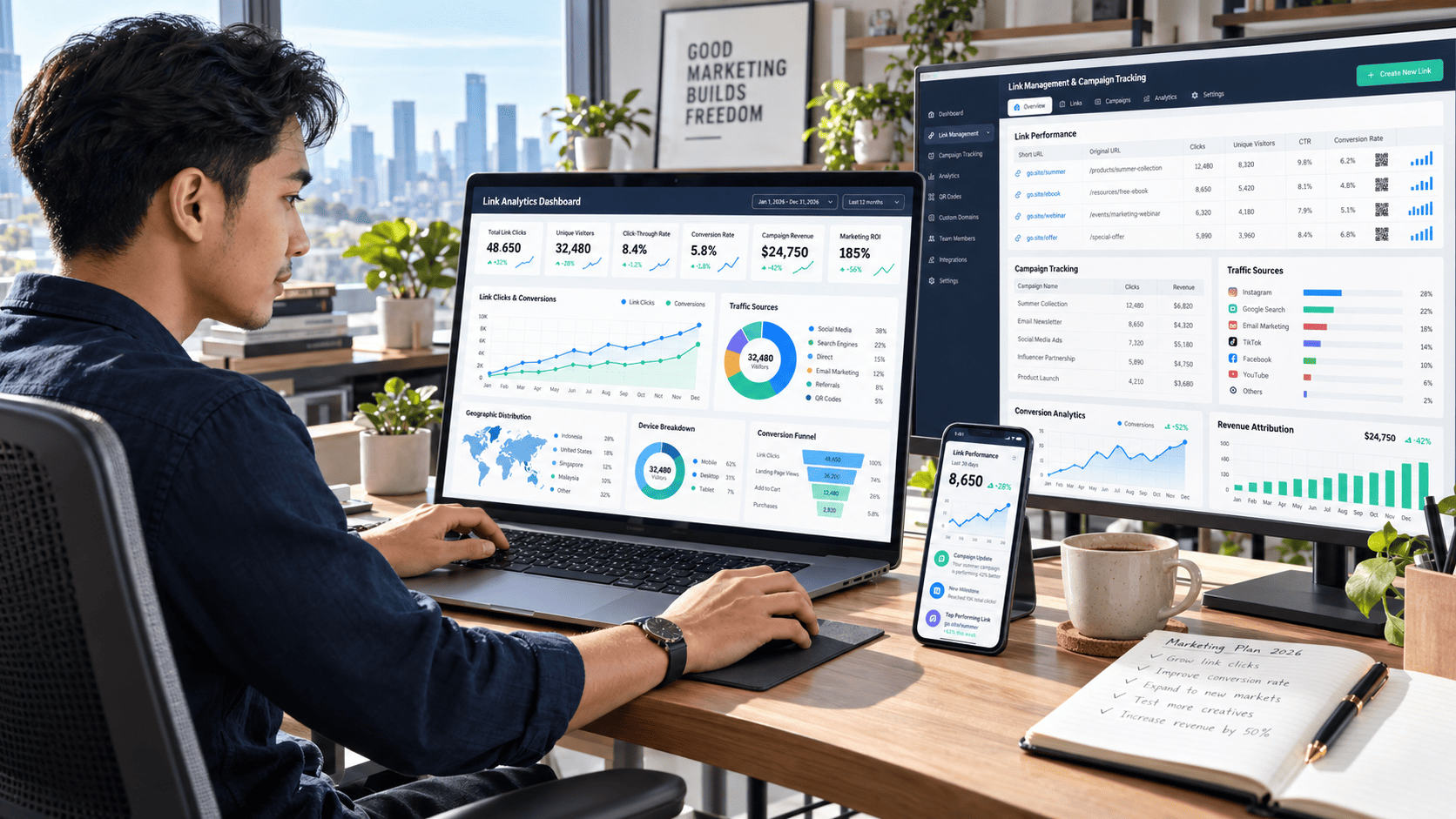
Someone sees a social media post, opens an email, finds your article through search, or taps an advertisement. A few seconds later, that visitor may become a subscriber, customer, or loyal follower. The problem is that without proper link management and analytics, much of that journey remains invisible.
You may know that a campaign generated traffic, but not which link performed best. You may see hundreds of visitors reaching a landing page without knowing where the most valuable users came from. Even worse, marketing decisions can end up being based on assumptions instead of actual behavior.
That is where link management and analytics become powerful.
By organizing links properly, tracking the right metrics, and understanding how visitors interact with each campaign, marketers, creators, affiliate publishers, and online businesses can transform ordinary links into reliable sources of audience intelligence.
Why Link Management & Analytics Matter More Than Ever
Modern digital marketing rarely depends on a single traffic source.
A potential customer might discover your brand through search, visit again through social media, click an email campaign several days later, and finally convert through a promotional landing page.
If every campaign uses random or poorly organized URLs, understanding that journey becomes difficult.
Effective link management creates structure. Analytics adds context.
Together, they help answer important questions such as:
- Which channels generate the most valuable traffic?
- Which campaign produces the highest conversion rate?
- What devices are visitors using?
- Which countries or regions generate stronger engagement?
- Which links receive clicks but fail to produce conversions?
- Where are users dropping out of the customer journey?
Instead of simply measuring traffic volume, you begin measuring traffic quality.
1. Build a Clear Link Management Structure
Good analytics starts before the first click happens.
If links are created without a consistent system, campaign reports quickly become messy. One person may label a campaign "facebook-sale," another may use "fbpromo," while another uses completely different naming conventions.
Months later, comparing performance becomes unnecessarily complicated.
Create Consistent Campaign Naming
Develop a simple naming system for every campaign.
For example:
- Channel: social, email, search, affiliate
- Campaign: summer-sale
- Content: video-a, banner-b, article-link
- Audience: returning-users, new-visitors
A structured URL might represent something like:
source=socialmedium=organiccampaign=summer-salecontent=video-a
Consistency makes reports easier to filter, compare, and understand.
Keep Links Organized
Create a central place where campaign links are documented.
A basic spreadsheet can include:
- Destination URL
- Campaign name
- Traffic source
- Date created
- Link owner
- Shortened URL
- UTM parameters
- Campaign status
For larger operations, dedicated link management platforms can automate much of this process.
2. Use UTM Parameters to Understand Traffic Sources
UTM parameters are among the simplest ways to improve marketing attribution.
They allow analytics platforms to identify where visitors came from and which campaign generated the click.
Common UTM parameters include:
UTM Source
Identifies the traffic source.
Examples:
- newsletter
- partner-site
UTM Medium
Describes the marketing channel.
Examples:
- social
- cpc
- referral
UTM Campaign
Identifies the campaign itself.
Examples:
- product-launch
- black-friday
- newsletter-september
UTM Content
Useful when testing multiple versions of the same campaign.
For example, two buttons inside the same email might use different content tags.
This makes it possible to discover which placement generates more engagement.
3. Track More Than Total Clicks
Click count is useful, but it rarely tells the entire story.
Imagine two links.
Link A generates 10,000 clicks and 100 sales.
Link B generates 4,000 clicks and 200 sales.
If you focus only on traffic volume, Link A looks stronger. But Link B produces a much higher conversion rate.
That is why successful link analytics focuses on multiple metrics.
Unique Clicks
Total clicks can include repeat visitors.
Unique clicks help estimate how many individual users actually interacted with the link.
Click-Through Rate
Click-through rate shows how effectively a link attracts attention.
A strong CTR may indicate that your headline, creative, placement, or call-to-action resonates with the audience.
Conversion Rate
Conversions reveal whether traffic actually produces the desired result.
Depending on the campaign, conversions could include:
- Purchases
- Newsletter signups
- Software registrations
- Contact form submissions
- Downloads
- Trial activations
A campaign with fewer clicks but stronger conversions can often be more valuable than a campaign generating massive low-quality traffic.
4. Uncover Hidden Audience Insights
One of the biggest advantages of link analytics is discovering patterns that are not immediately obvious.
For example, you might discover that mobile visitors dominate overall traffic but desktop users generate most purchases.
Or perhaps traffic from one country represents only 15% of clicks but produces 35% of conversions.
Those insights can influence future marketing decisions.
Analyze Geographic Performance
Geographic data can reveal which countries, cities, or regions respond best to specific campaigns.
This information can help with:
- Localized campaigns
- Regional promotions
- Advertising budgets
- Language optimization
- Product availability
Analyze Device Usage
Visitors may interact differently depending on whether they use a smartphone, tablet, or desktop computer.
If a campaign receives large mobile traffic but poor mobile conversions, the problem may not be the campaign itself.
The landing page could simply be difficult to use on smaller screens.
Study Visitor Timing
Analytics may also reveal when audiences are most active.
If most clicks occur between 7 PM and 10 PM, publishing content or sending campaigns during that window could improve engagement.
5. Connect Click Data With Conversion Data
Clicks alone represent interest.
Conversions represent results.
The real value of link management and analytics appears when both datasets are connected.
Suppose an email campaign sends 5,000 visitors to your website.
At first glance, that sounds impressive.
But deeper analysis might show:
- 5,000 visitors
- 250 product views
- 70 checkout sessions
- 20 purchases
Now the problem becomes easier to identify.
The email may be generating traffic successfully, while the landing page or product offer needs improvement.
Without conversion tracking, you might mistakenly blame the traffic source.
6. Use Link Analytics for A/B Testing
A/B testing allows marketers to compare different versions of a campaign.
You could test:
- Headlines
- Call-to-action buttons
- Images
- Landing pages
- Offers
- Link placements
- Email subject lines
For example, imagine two CTA variations:
Version A: Learn More
Version B: Start Your Free Trial
Both links lead to the same page but use separate tracking parameters.
After several thousand impressions, Version B may generate fewer clicks but more registrations.
That is the kind of insight that improves marketing performance over time.
7. Identify High-Performing Traffic Sources
Not every traffic channel produces the same value.
Search visitors may spend more time reading.
Email subscribers may convert better.
Social media users may generate large traffic spikes but shorter sessions.
Affiliate visitors may arrive with stronger purchase intent.
Link analytics makes those differences measurable.
Compare Traffic Quality
Instead of asking:
"Which source brings the most visitors?"
Ask:
"Which source brings the most valuable visitors?"
Compare metrics such as:
- Conversion rate
- Revenue per visitor
- Engagement time
- Pages per session
- Repeat visits
- Customer acquisition cost
This prevents marketing budgets from being wasted on channels that produce impressive numbers but weak business results.
8. Watch for Broken and Expired Links
Link management is not only about tracking performance.
It is also about maintaining reliability.
Broken links create poor user experiences and can waste valuable traffic.
Common causes include:
- Deleted pages
- Changed URLs
- Expired promotions
- Incorrect redirects
- Domain migrations
Regular link audits help identify these problems before they affect large numbers of visitors.
Use Redirects Carefully
If an important destination changes, create a proper redirect instead of abandoning the original URL.
This keeps existing backlinks, social posts, email campaigns, and bookmarks functional.
9. Create Real-Time Campaign Monitoring
Some campaigns move quickly.
A promotional post might suddenly go viral. An influencer mention could produce thousands of visitors within minutes. An advertising campaign might generate unexpected traffic from a new region.
Real-time analytics allows you to react quickly.
You might notice:
- Sudden traffic spikes
- Unexpected referral sources
- High bounce rates
- Conversion drops
- Suspicious click patterns
Fast detection makes it easier to fix landing page problems, adjust budgets, or investigate unusual traffic before the issue becomes larger.
10. Turn Analytics Into Action
Collecting data is easy.
Using it well is harder.
A dashboard filled with charts has little value unless those numbers influence decisions.
A simple monthly review can focus on four questions:
What Worked?
Identify campaigns with strong conversions, engagement, or revenue.
What Underperformed?
Look for links generating traffic without meaningful results.
What Changed?
Compare performance across weeks or months.
Unexpected changes may reveal new audience behavior or technical problems.
What Should Be Tested Next?
Every analytics report should lead to at least one practical experiment.
It might involve changing a CTA, testing a new channel, improving mobile usability, or rewriting a landing page headline.
Common Link Analytics Mistakes to Avoid
Even experienced marketers can create tracking problems.
Some of the most common mistakes include:
- Using inconsistent UTM naming
- Tracking clicks without conversions
- Creating unnecessary short links
- Ignoring mobile performance
- Forgetting to test campaign URLs
- Changing tracking parameters during an active campaign
- Looking only at vanity metrics
- Failing to document campaign links
Small tracking mistakes can produce misleading reports, so keeping the system simple and consistent is usually better than creating an overly complicated setup.
A Simple Link Management Workflow
A practical workflow does not need dozens of tools.
Before launching a campaign:
- Choose the destination page.
- Define the campaign source and medium.
- Create standardized tracking parameters.
- Generate the campaign link.
- Test the URL on desktop and mobile.
- Record the link in your campaign database.
- Launch the campaign.
- Monitor clicks and conversions.
- Compare traffic sources.
- Use the findings to improve the next campaign.
Repeating this process builds a valuable history of marketing performance.
Over time, patterns become easier to recognize.
You may discover which content formats work best, which audience segments convert more often, and which channels deserve additional investment.
Conclusion: Make Every Click More Valuable
Effective link management and analytics is not about collecting more numbers. It is about understanding what those numbers reveal about real people moving through your marketing ecosystem.
A well-organized tracking system allows you to see where visitors come from, what attracts their attention, how they behave after clicking, and which campaigns ultimately produce meaningful results.
Start with consistent link naming, use UTM tracking carefully, measure conversions alongside clicks, and regularly compare traffic quality across channels. Then turn those insights into experiments that continuously improve performance.
Every campaign generates data. The brands and creators that learn how to interpret that data gain a powerful advantage.
Review your active campaign links today, improve anything that cannot be clearly tracked, and begin turning every click into an opportunity to understand your audience better and grow conversions more intelligently.