Have you ever shared a link across multiple platforms, watched the clicks roll in, and wondered why those visitors weren't turning into customers?
You're not alone. Many marketers, bloggers, affiliate publishers, and business owners focus heavily on generating traffic without understanding what happens after someone clicks.
The truth is that more clicks don't automatically mean more conversions. A campaign attracting thousands of visitors can underperform compared to one generating a few hundred highly targeted clicks.
That's where link analytics becomes a game changer.
By tracking how people interact with your links, you can discover which marketing channels deliver valuable traffic, what content encourages action, and where potential customers lose interest.
Whether you're managing affiliate links, running social media campaigns, or promoting an online business, mastering link analytics can help you make smarter marketing decisions.
Let's explore the proven strategies that turn ordinary click data into meaningful business growth.
What Is Link Analytics and Why Does It Matter?
Link analytics is the process of collecting, measuring, and analyzing data generated when users interact with tracked links.
Instead of simply counting clicks, modern link analytics solutions can reveal valuable information about traffic sources, devices, geographic locations, campaign performance, and user engagement.
For example, imagine promoting the same product through Facebook, Instagram, and email marketing.
Without proper tracking, you might only know that your website received 3,000 visitors.
With link analytics, you could discover that:
Facebook generated 1,500 visits but relatively few purchases.
Instagram attracted 900 visits with strong engagement.
Email marketing brought 600 visits and produced the highest conversion rate.
These insights allow you to focus your budget and effort on channels that actually contribute to your goals.
The Difference Between Click Tracking and Link Analytics
Although these terms are closely related, they serve different purposes.
Click tracking records interactions with specific links, including when a click occurred and which tracked link received it.
Link analytics takes that information further by examining patterns, campaign attribution, audience behavior, and measurable outcomes.
A click counter tells you how many people clicked. Link analytics helps you understand whether those clicks created value.
Set Clear Conversion Goals Before Tracking Links
One of the biggest mistakes in digital marketing is collecting large amounts of data without establishing meaningful objectives.
Before building a tracking system, define what success looks like.
For an e-commerce business, success might mean completed purchases. For a blogger, it could involve newsletter subscriptions, while an affiliate marketer may prioritize verified referrals or commissions.
Choose the Right Key Performance Indicators
Several important metrics can help evaluate link performance.
| Metric | What It Measures |
|---|---|
| Clicks | Total recorded link interactions |
| Click-through rate (CTR) | Percentage of eligible impressions that generate clicks |
| Conversion rate | Percentage of visitors or clicks resulting in desired actions |
| Cost per acquisition (CPA) | Marketing cost required to acquire one conversion |
| Revenue per click (RPC) | Revenue generated per tracked click |
| Return on ad spend (ROAS) | Revenue attributed to advertising divided by ad spending |
Different platforms may define these metrics differently, so consistent measurement is essential.
Focus on Quality Instead of Vanity Metrics
A campaign generating 10,000 clicks might look impressive, but those numbers mean little if users immediately leave without taking action.
Consider two hypothetical campaigns:
Campaign A: 5,000 clicks and 50 conversions.
Campaign B: 2,000 clicks and 100 conversions.
Campaign A converts at 1%, while Campaign B converts at 5%.
Despite attracting fewer clicks, Campaign B delivers twice as many conversions.
This demonstrates why conversion-focused link analytics is more valuable than relying on traffic volume alone.
Master UTM Parameters for Accurate Link Analytics
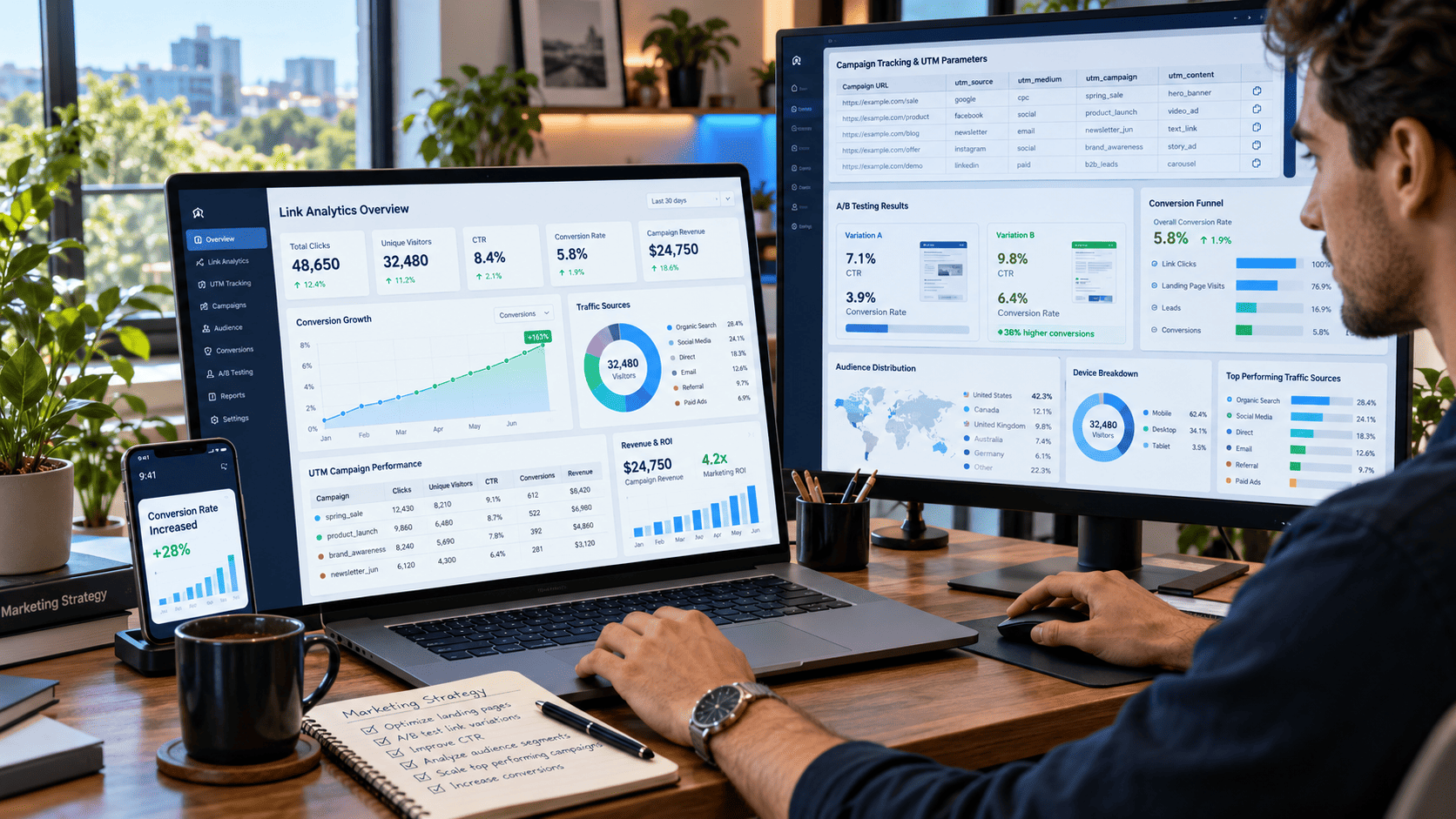
UTM parameters are among the most practical tools for understanding where your website traffic originates.
These tracking tags are added to URLs and help analytics platforms identify marketing campaigns.
For example:
https://example.com/product?utm_source=facebook&utm_medium=social&utm_campaign=summer_sale
Each parameter serves a specific purpose.
Understanding the Essential UTM Parameters
utm_source: Identifies the traffic source, such as Facebook or a newsletter.
utm_medium: Describes the marketing channel, such as social, email, or paid advertising.
utm_campaign: Identifies the campaign being promoted.
utm_content: Distinguishes individual advertisements, buttons, or creative variations.
utm_term: Can identify paid search keywords or other explicitly defined targeting details.
Build a Consistent Naming System
Consistency is critical when managing multiple campaigns.
Using Facebook, facebook, and fb inconsistently can fragment reporting because analytics systems may treat these values differently.
Create standardized naming conventions and document them for your marketing team.
Avoid Common UTM Tracking Mistakes
Never attach sensitive personal information to UTM parameters. URLs can appear in browser histories, analytics systems, server logs, and shared reports.
Additionally, avoid placing campaign UTM parameters on internal website navigation links. Doing so can overwrite valuable acquisition attribution data.
A well-structured UTM strategy makes campaign reporting clearer and more reliable.
Use Link Analytics to Understand Audience Behavior
Understanding who clicks your links is helpful, but understanding how those visitors behave afterward is even more powerful.
Advanced analytics can combine link interaction data with website engagement and conversion events.
Analyze Traffic Sources and Devices
Different audiences behave differently depending on where they encounter your links.
Visitors arriving through email newsletters may already trust your brand, while people discovering your business through social media might need more information before purchasing.
Device information also reveals optimization opportunities.
For example, if mobile users generate most clicks but convert less frequently than desktop users, investigate whether your mobile checkout experience creates unnecessary friction.
Discover Geographic Performance Patterns
Geographic reporting can identify regions that generate meaningful engagement.
However, location information derived from IP addresses is approximate and should not be treated as a precise representation of a person's physical location.
Use regional insights to improve language choices, campaign timing, and localized content rather than making assumptions about individual visitors.
Improve Conversions Through A/B Testing
A/B testing compares two variations of a marketing element to determine which performs better against a defined objective.
Instead of guessing which link placement or call-to-action works best, you can measure actual audience responses.
Test One Meaningful Variable at a Time
Consider an email campaign promoting a downloadable marketing guide.
Version A uses the CTA:
"Download the Free Guide"
Version B uses:
"Get Your Marketing Guide Today"
By randomly assigning recipients to each version, you can compare results more reliably.
Other useful variables include:
CTA wording and button placement.
Landing page headlines.
Promotional images.
Link positioning within articles.
Offer descriptions and messaging.
Evaluate Results Beyond Clicks
Suppose Version B produces more clicks but fewer downloads.
That suggests the CTA attracts attention without necessarily matching visitors' expectations.
Track the complete conversion journey rather than declaring a winner based solely on CTR.
For reliable conclusions, account for sample size, random variation, and the duration of the test.
Optimize Landing Pages After Every Click
Even an excellent link tracking strategy cannot rescue a confusing landing page.
Once visitors click, the destination must deliver on the promise that attracted them.
Match Your Message With Visitor Expectations
Imagine clicking an advertisement promising a free SEO checklist and landing on a page promoting an expensive consulting package.
That mismatch can damage trust and reduce conversions.
Instead, maintain consistency between the link description, landing page headline, and primary offer.
Remove Unnecessary Conversion Barriers
Effective landing pages generally share several characteristics:
A clear headline communicating the main benefit.
Fast loading and mobile-friendly design.
Relevant content matching the original promotion.
A visible, understandable call-to-action.
A simple form or checkout experience.
Trust-building information such as transparent policies and credible testimonials.
Small improvements can have meaningful effects, particularly when applied to high-traffic pages.
Connect Link Analytics With Conversion Tracking
Clicks and conversions often occur in separate systems.
A link management platform might record a click, while a website analytics platform records the resulting purchase or registration.
Connecting these datasets provides a more complete picture of campaign effectiveness.
Track the Entire Customer Journey
A typical customer journey might look like this:
Tracked Link → Landing Page → Product View → Add to Cart → Checkout → Purchase
Each stage reveals potential opportunities for improvement.
For example, strong product-page engagement followed by substantial checkout abandonment could indicate unexpected shipping costs, confusing payment options, or technical problems.
Use Event-Based Analytics
Tools such as Google Analytics 4 can measure events associated with important actions, including registrations, purchases, and form submissions.
Where technically appropriate, connect campaign identifiers with conversion events to evaluate performance across marketing channels.
Respect consent requirements and applicable privacy laws when collecting behavioral data.
Automate Reports Without Losing Valuable Insights
As marketing operations expand, manually reviewing dozens of campaigns becomes inefficient.
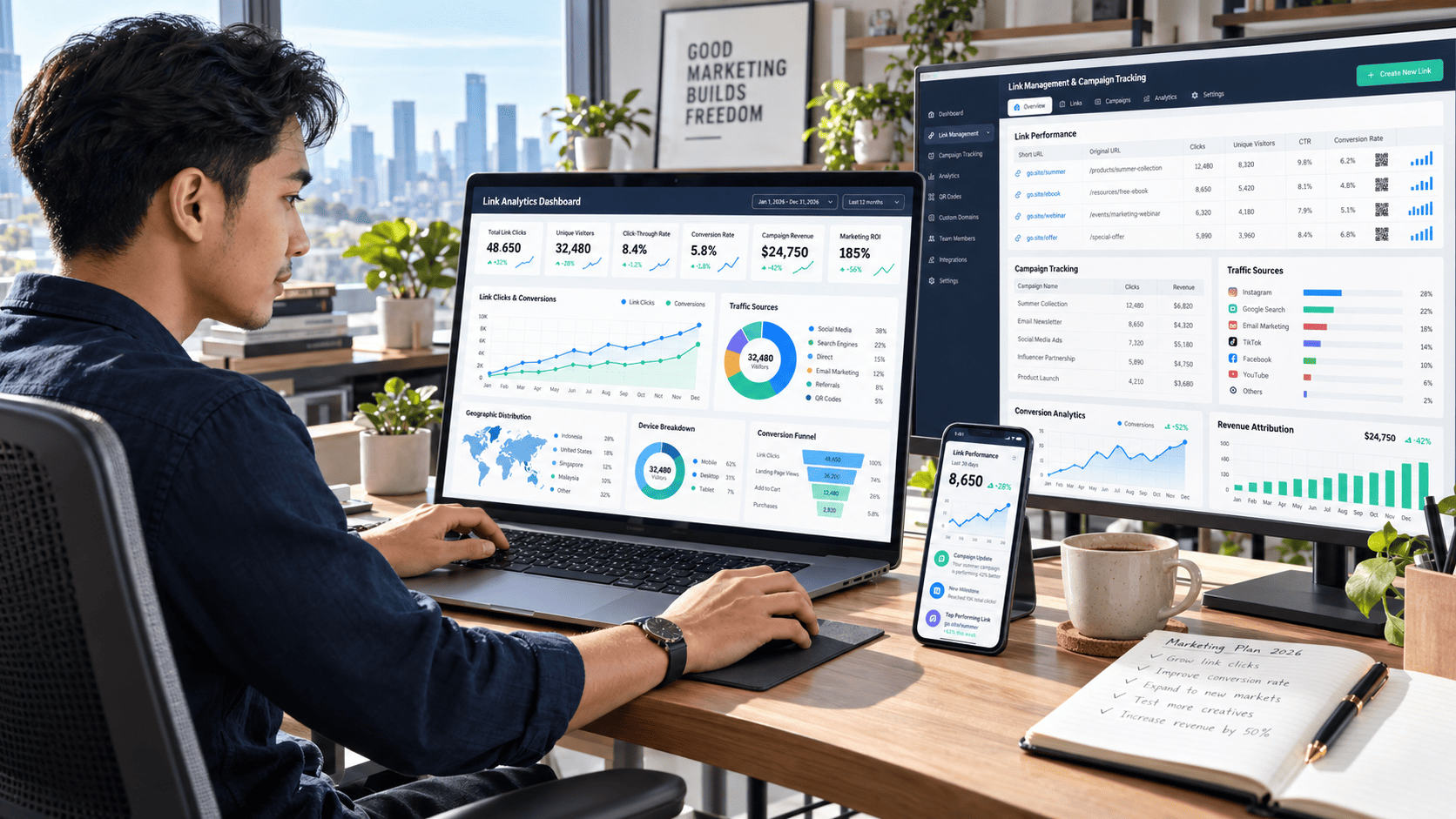
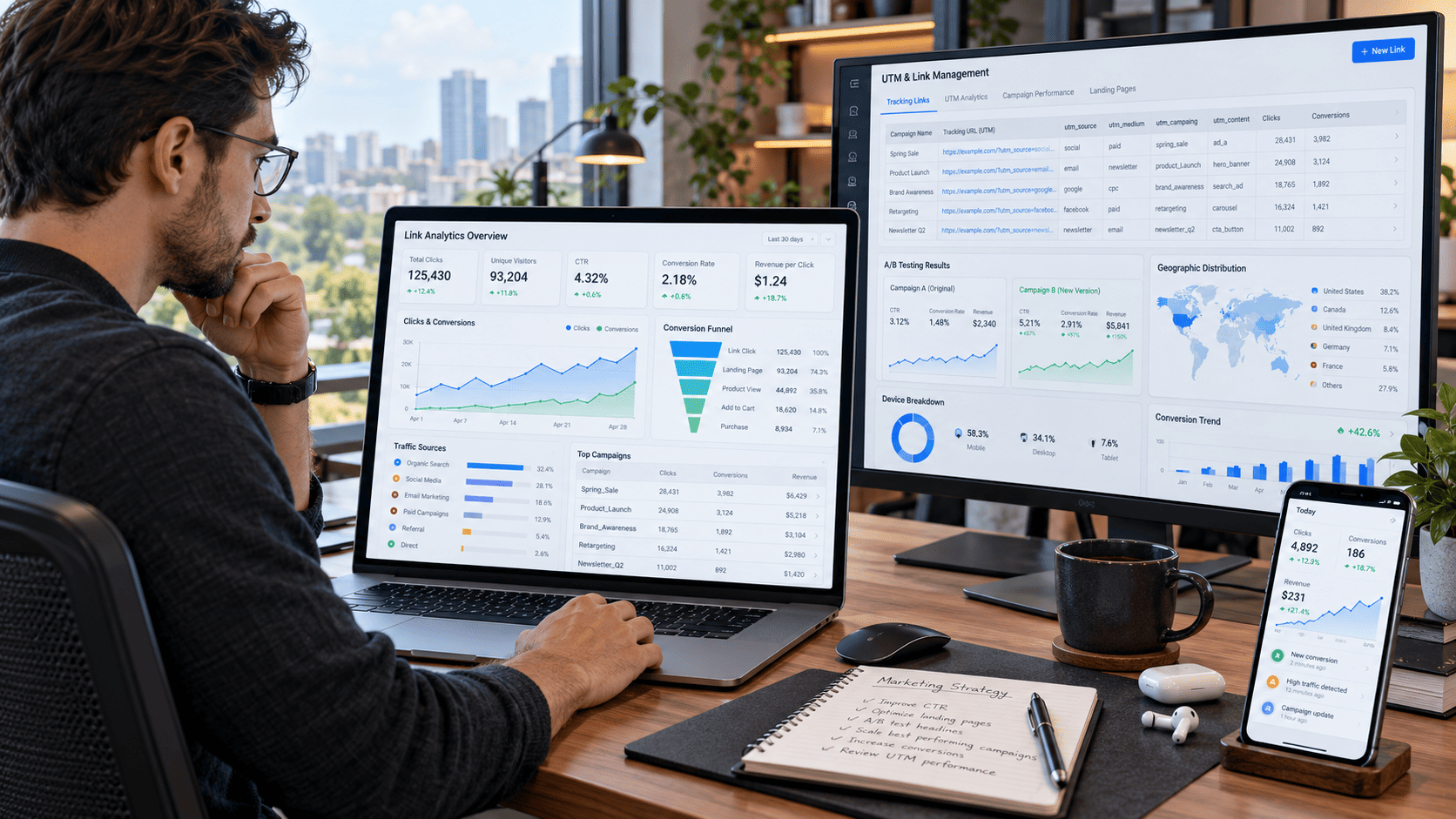
Automated dashboards help consolidate performance metrics into a single reporting environment.
Build a Practical Link Analytics Dashboard
A useful dashboard might include:
Daily and weekly click trends.
Traffic sources and campaign comparisons.
Conversion rates by channel.
High-performing landing pages.
Revenue and acquisition costs.
Device-level performance.
Unusual traffic spikes or tracking failures.
These metrics make it easier to identify meaningful changes without searching through multiple reports.
Watch for Invalid or Duplicate Clicks
Not every recorded click represents a genuine potential customer.
Automated bots, repeated interactions, preview crawlers, and accidental clicks may distort reporting.
Use appropriate filtering methods and compare link-level measurements with website analytics.
Remember that different measurement platforms can legitimately report different totals because of attribution rules, privacy settings, filtering, and tracking limitations.
Turn Link Analytics Insights Into Smarter Marketing Decisions
The ultimate purpose of link analytics is not creating attractive dashboards. It's improving decisions.
Establish a regular performance review process and identify patterns worth investigating.
For example, you might discover that educational articles generate fewer clicks than promotional posts but lead to more newsletter subscribers.
Rather than immediately increasing promotional content, you could invest in useful educational resources and test stronger subscription opportunities.
Similarly, if one campaign produces a high acquisition cost with limited conversions, consider improving its targeting or landing page before increasing spending.
Successful optimization follows a repeatable cycle:
Measure → Analyze → Form a Hypothesis → Test → Improve
Over time, this approach can reduce wasted marketing effort and help create more predictable results.
Conclusion: Unlock the Real Power of Link Analytics
Mastering link analytics means looking beyond basic click counts and understanding how each interaction contributes to your marketing goals.
By combining consistent UTM tracking, audience insights, conversion measurement, A/B testing, and landing page optimization, you can uncover opportunities that ordinary traffic reports may overlook.
The most effective marketers don't simply chase higher numbers. They use reliable data to understand visitor behavior, improve customer experiences, and allocate resources more intelligently.
Start by reviewing your most important marketing links, setting clear conversion goals, and identifying one measurable improvement opportunity.
Ready to turn more clicks into meaningful conversions? Put these proven link analytics strategies into practice, monitor the results, and share this guide with anyone looking to make smarter, data-driven marketing decisions.