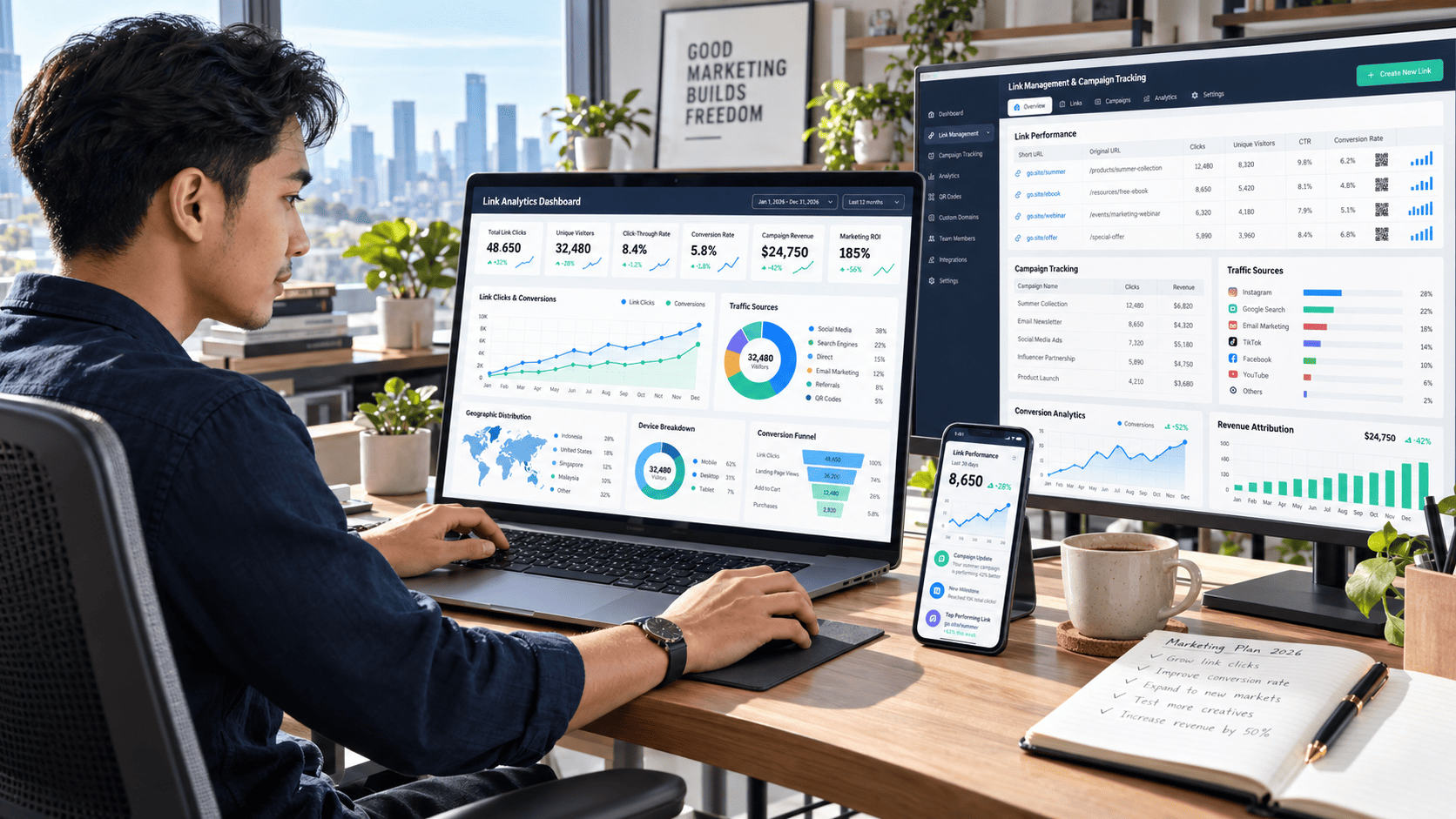
Getting more website traffic feels like progress—until you realize that thousands of clicks mean very little when you do not know where those visitors came from, what they clicked, or why they disappeared without converting.
That is where link management & analytics becomes incredibly valuable.
Instead of treating every link as a simple path from one page to another, smart marketers use links as measurable touchpoints. Every click can reveal something about audience intent, traffic quality, campaign performance, device preferences, geographic location, and the journey people take before becoming customers.
When your links are organized properly and supported by accurate analytics, you stop guessing. You can see which campaigns deserve more attention, which channels are wasting traffic, and which small changes could dramatically improve conversions.
The formula is simple: organize your links, track meaningful data, analyze visitor behavior, optimize what works, and continuously improve the customer journey.
Why Link Management & Analytics Matters More Than Ever
Modern audiences rarely interact with a brand through only one channel.
Someone might discover your content through social media, click a link in an email two days later, visit a landing page through search, and finally convert after seeing another campaign.
Without proper link tracking, those interactions may look completely unrelated.
Link management & analytics helps connect those dots.
For marketers, content creators, affiliate publishers, online businesses, and agencies, this means gaining a clearer understanding of how people actually interact with campaigns.
Instead of only asking, “How many people clicked?”
You can ask better questions:
- Which traffic source generated the click?
- Which campaign produced the strongest engagement?
- What device did the visitor use?
- Which landing page performed best?
- Which audience segment converted?
- Where did visitors drop out?
- Which links contributed to actual revenue?
Those answers turn basic click statistics into actionable marketing intelligence.
Build a Strong Link Management Foundation
Before diving into complicated analytics dashboards, start with organization.
Poorly managed links quickly become confusing when campaigns begin multiplying across websites, newsletters, advertisements, social media posts, and landing pages.
Create a Clear Link Naming System
Imagine running five campaigns across Facebook, email, paid search, Instagram, and a blog. If every tracking link uses random names, analyzing performance later becomes unnecessarily difficult.
A structured naming system makes reporting easier.
For example:
campaign-summer-email-product
is much easier to understand than:
campaign-2738-final-new2
The exact structure can vary, but consistency matters more than complexity.
A useful naming system may include:
- Campaign name
- Traffic source
- Content type
- Audience segment
- Promotion or product
- Date or campaign period
Once everyone follows the same format, link reports become far easier to interpret.
Keep Important Links Organized
A centralized link library can prevent duplicated URLs, outdated destinations, and tracking mistakes.
Organize links by campaign, department, traffic source, or content category.
For example:
Social Campaigns
Store links used in Facebook, Instagram, LinkedIn, TikTok, or other social channels.
Email Campaigns
Separate newsletter links, promotional campaigns, onboarding sequences, and automated email flows.
Paid Advertising
Keep landing-page links for search ads, display campaigns, retargeting, and sponsored content organized separately.
This simple structure can save hours when campaigns grow.
Track Every Click With Meaningful Data
Tracking clicks is easy.
Tracking the right information is where the real value appears.
A raw number such as “8,000 clicks” sounds impressive, but it does not explain whether those clicks produced meaningful business results.
Monitor Traffic Sources
Start by identifying where visitors actually come from.
Common sources include:
- Organic search
- Social media
- Paid advertising
- Referral websites
- Direct traffic
- Affiliate campaigns
Traffic-source analysis helps reveal which channels consistently attract valuable visitors.
For example, one social campaign might generate 10,000 clicks but only a handful of conversions, while an email campaign produces just 2,000 clicks and hundreds of qualified leads.
Without deeper analytics, the larger traffic number can easily create the wrong impression.
Use Campaign Parameters Consistently
Campaign tracking parameters help analytics platforms identify where traffic originates.
UTM parameters are among the most widely used methods.
A tracked campaign URL might contain information about:
- Source
- Medium
- Campaign
- Content
- Term
For example, two links leading to the same landing page can still be measured separately when one appears in an email newsletter and another appears in a social campaign.
The destination remains the same, but the tracking information reveals which channel produced the visit.
Avoid Messy Tracking Structures
Consistency is essential.
If one campaign uses:
facebook
and another uses:
Facebook
while another uses:
fb
analytics systems may treat them as separate sources.
Creating simple tracking rules prevents fragmented reporting.
A standardized structure makes future comparisons much more reliable.
Reveal Hidden Audience Insights
Clicks contain valuable behavioral clues.
When those clicks are combined with audience analytics, patterns begin to emerge.
Analyze Device Usage
Visitors may behave very differently depending on whether they use:
- Desktop computers
- Smartphones
- Tablets
Suppose mobile users represent 75% of your traffic but convert significantly less than desktop users.
The problem might not be the campaign.
Your mobile landing page could simply be too slow, confusing, or difficult to navigate.
Without device-level analytics, that opportunity might remain hidden.
Understand Geographic Performance
Geographic data can reveal markets where campaigns perform unexpectedly well.
You might discover that visitors from one city, region, or country engage more frequently or convert at a higher rate.
That information can influence advertising budgets, content strategy, localization, and future campaign targeting.
Compare New and Returning Visitors
New visitors and returning users often behave differently.
A first-time visitor may explore educational content, while someone returning for the fourth time may already be evaluating a product.
Understanding these patterns helps businesses build more relevant customer journeys.
Connect Clicks With Conversion Data
One of the biggest mistakes in digital marketing is treating clicks as the final goal.
Clicks are only one part of the journey.
The real question is what happens after the click.
Define Important Conversion Events
Conversions can mean different things depending on the business.
Common examples include:
- Product purchases
- Newsletter subscriptions
- Lead form submissions
- Account registrations
- App downloads
- Demo requests
- Booking confirmations
- Affiliate purchases
Tracking these actions alongside link data shows which campaigns actually create measurable results.
Look Beyond Click-Through Rate
A campaign with a high click-through rate is not automatically successful.
Consider two campaigns:
Campaign A generates 5,000 clicks and 50 sales.
Campaign B generates 2,000 clicks and 120 sales.
Campaign A produces more traffic, but Campaign B creates far more value per visitor.
That is why link analytics should always connect engagement metrics with conversion performance.
Map the Customer Journey
Visitors rarely follow a perfectly straight path from advertisement to purchase.
A more realistic journey might look like this:
Social Post → Blog Article → Email Signup → Product Page → Purchase
Every link plays a role.
Customer journey analysis helps identify which touchpoints contribute to conversions.
Identify High-Value Touchpoints
Some pages may rarely produce direct sales but still influence many successful customer journeys.
For example, a detailed educational guide might introduce thousands of visitors to your brand.
Those visitors may return days later through email or search before converting.
Looking only at the final click could make that guide appear less valuable than it actually is.
Use Link Analytics to Improve Campaign Performance
Analytics should lead to action.
Collecting mountains of data without making changes provides little value.
A simple optimization cycle works well:
- Measure campaign performance.
- Identify unusual patterns.
- Form a hypothesis.
- Make one meaningful change.
- Compare the results.
- Repeat the process.
Find Underperforming Links
Look for links with strong traffic but weak results.
Possible problems might include:
- Slow landing pages
- Confusing calls-to-action
- Poor mobile design
- Mismatched audience expectations
- Broken pages
- Weak offers
Each underperforming link represents an optimization opportunity.
Double Down on High-Performing Channels
Analytics can also reveal where resources should be increased.
If one traffic source consistently delivers engaged visitors and strong conversion rates, expanding campaigns there may produce better returns than simply chasing larger traffic numbers elsewhere.
Test Different Link Placements and Messages
Small changes can produce surprisingly large differences in click behavior.
Consider testing:
- Call-to-action wording
- Button placement
- Landing-page headlines
- Email link positions
- Promotional messages
- Content formats
- Destination pages
Change One Variable at a Time
Testing several major changes simultaneously makes it difficult to know what caused the result.
A cleaner approach is to test one important variable, measure the outcome, and then move to the next experiment.
Over time, those incremental improvements can significantly increase conversion rates.
Keep Your Analytics Clean and Reliable
Analytics are only useful when the data is trustworthy.
Poor tracking can produce misleading conclusions.
Review your setup regularly for:
- Duplicate tracking
- Broken links
- Incorrect campaign parameters
- Internal employee traffic
- Bot activity
- Missing conversion events
- Outdated landing pages
A simple monthly tracking audit can prevent small data problems from becoming major reporting issues.
Turn Analytics Into Decisions, Not Just Reports
Beautiful dashboards are useful, but dashboards themselves do not improve campaigns.
Decisions do.
A useful analytics report should quickly answer three questions:
What Happened?
Identify meaningful changes in traffic, clicks, engagement, or conversions.
Why Did It Happen?
Investigate campaign sources, audience segments, devices, content, and landing pages.
What Should Change Next?
Translate insights into practical actions.
For example:
Traffic increased 40%, but conversions stayed flat.
Further analysis shows that most new visitors came from mobile social traffic.
Mobile users experienced poor landing-page engagement.
The next action becomes clear: improve the mobile landing experience before spending more money to acquire additional traffic.
That is the difference between simply collecting analytics and actually using them.
Create a Continuous Link Optimization System
Effective link management & analytics is not a one-time project.
Campaigns change. Audiences change. Traffic sources evolve. New landing pages appear. Old links become irrelevant.
A simple recurring workflow can keep everything organized:
- Create properly tracked links.
- Launch the campaign.
- Monitor traffic and click behavior.
- Compare audience segments.
- Measure conversions.
- Identify strong and weak touchpoints.
- Test improvements.
- Document successful patterns.
- Apply those insights to future campaigns.
Over time, every campaign teaches you something about your audience.
That accumulated knowledge becomes a competitive advantage.
Conclusion: Turn Every Click Into Smarter Growth
Traffic alone does not create sustainable growth. Understanding what happens behind every click does.
A strong link management & analytics strategy allows you to organize campaigns, track traffic accurately, uncover hidden audience insights, understand customer journeys, and connect marketing activity with real conversions.
The goal is not simply to collect more data. It is to make better decisions with the data you already have.
Start by organizing your links, standardizing campaign tracking, monitoring meaningful conversion events, and reviewing audience behavior regularly. Then use those insights to improve landing pages, refine campaigns, and invest more resources in the channels that consistently deliver results.
Every click leaves a clue. The better you become at reading those clues, the easier it becomes to turn ordinary traffic into measurable growth.
Review your current campaigns today, identify one link you are not tracking properly, and improve it. Small improvements in tracking can reveal insights that completely change how you approach your next campaign.